

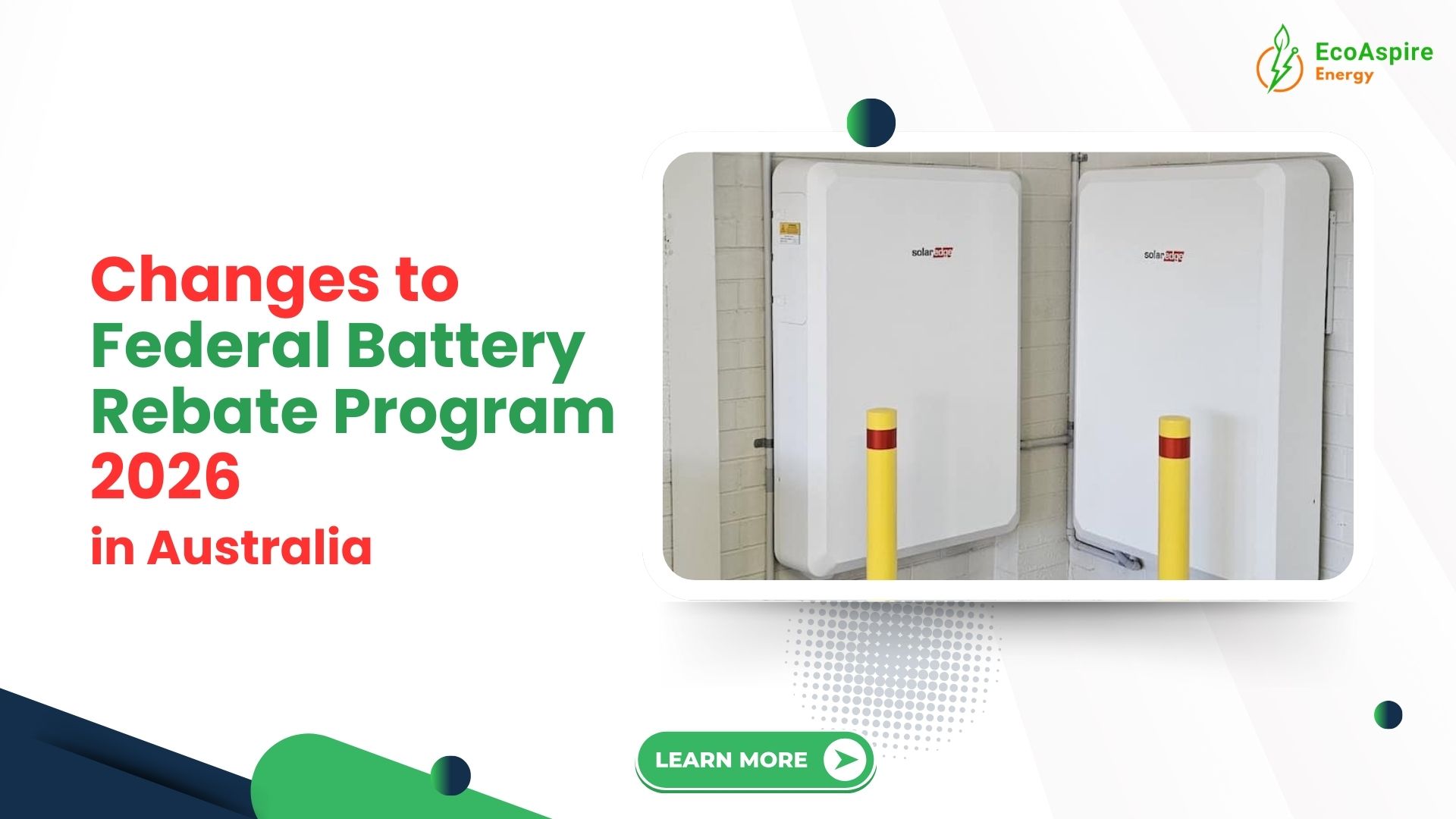
The changes to federal battery rebate program in 2026 mark one of the most important shifts in Australia’s renewable energy support system. With the proposed STC factor reductions now officially passed and implemented, both homeowners and businesses must understand how battery rebates have changed and what it means for battery installations across Australia in 2026.
Table of Contents
ToggleHowever, in 2026, the Australian Government introduced important changes to federal battery rebate, which directly affect how much homeowners can save, which systems qualify, and how installations must be carried out. Understanding these updates is crucial for anyone planning a solar battery installation.
This guide explains the solar battery rebate Australia 2026, explores the implications of the changes to battery rebate 2026, details costs and eligibility, and shows how Eco Aspire Energy, a leading solar provider, helps customers maximise savings and compliance with ease.
What Changed in the Solar Battery Rebate for 2026?
The changes to battery rebate 2026 introduced stricter eligibility criteria, updated safety and performance standards, and revised rebate structures for solar battery installations. While rebates remain accessible, homeowners must now use approved battery systems and Clean Energy Council–accredited installers to qualify.
These changes were implemented to:
- Protect homeowners from poor-quality systems
- Ensure long-term system reliability and safety
- Encourage sustainable energy storage and reduce grid dependence
At Eco Aspire Energy, we make sure every system complies with the 2026 rules while optimising savings.
Understanding the Federal Battery Rebate in Australia
The federal battery rebate supports Australia’s renewable energy strategy by encouraging households to store solar energy rather than exporting it back to the grid.
Why the Federal Battery Rebate is Updated in 2026
The update addresses key issues:
- Safety concerns related to improper battery installations
- Low-quality systems reducing long-term efficiency
- Short battery lifespans impacting cost-effectiveness
- Increased demand on the national electricity grid
The government now prioritises systems that are high-quality, safe, and efficient over short-term installation volume. Homeowners must understand that non-compliance can result in denied rebate applications or financial penalties.
How the Federal Rebate Works
Eligible households can receive financial support for approved battery systems. Rebates are generally calculated based on:
- Battery capacity (kWh)
- System type (residential or commercial)
- Use of Clean Energy Council–approved equipment and installers
Eco Aspire Energy manages the process end-to-end, ensuring every rebate application complies with federal standards. This reduces the risk of delays or rejected applications, a common problem for homeowners navigating the new 2026 rules.
Why the Australian Government Changed the Battery Rebate
The Australian Government revised the solar battery rebate to ensure the Cheaper Home Batteries Program can continue until around 2030. Due to strong demand, the original $2.3 billion budget was being used much faster than expected, with a large share of funding going to oversized battery systems. This reduced the program’s ability to support a wider number of households and businesses.
Key Reasons for the Changes:
- Budget Pressure: High uptake of battery installations, especially large systems, caused funds to deplete more quickly than planned.
- Program Longevity: Changes were needed to stretch available funding so more Australians can access the rebate over the full life of the program.
- Reducing Oversized Installations: The new tiered rebate structure lowers support for batteries above 14kWh, preventing large systems from consuming a disproportionate share of the budget.
- Maintaining Fair Value: The adjustments aim to keep the average rebate at around 30%, while aligning support with declining battery costs over time.
Changes to the Federal Battery Rebate Program in Australia
From 1 May 2026, key changes to the Federal Battery Rebate Program take effect under Australia’s Cheaper Home Batteries Program. Following the government’s expanded funding announcement in December 2025, the updated rules adjust how Small-scale Technology Certificates (STCs) are calculated to keep battery discounts near 30% while aligning with falling battery costs. The changes apply nationwide and affect both home and business battery installations in 2026.
Year | Period | STC Factor (Before Change) | Proposed STC Factor (Already Executed) |
2026 | Jan – Apr | 8.4 | 8.4 |
2026 | May – Dec | 8.4 | 6.8* |
2027 | Jan – Jun | 7.4 | 5.7 |
2027 | Jul – Dec | 7.4 | 5.2 |
2028 | Jan – Jun | 6.5 | 4.6 |
2028 | Jul – Dec | 6.5 | 4.1 |
2029 | Jan – Jun | 5.6 | 3.6 |
2029 | Jul – Dec | 5.6 | 3.1 |
2030 | Jul – Dec | 4.7 | 2.6 |
2030 | Jul – Dec | 4.7 | 2.1 |
*From 1st May 2026 to 31th Dec 2026
Change 1 – From 1 January 2026: Lower STC Factor
From 1 January 2026, the STC Factor reduces from 9.3 to 8.4. This results in a slight reduction in the rebate value per kilowatt-hour (kWh) of battery storage.
There is no change to the subsidy tiering at this stage, meaning battery systems up to 50kWh continue to receive 100% of the applicable rebate.
Example:
A 30kWh battery that previously generated 279 STCs will now generate 252 STCs, reducing the rebate by approximately $1,000, based on an STC value of around $38.
Change 2 – From 1 May 2026: Major Rebate Reduction
The most significant Changes to the Federal Battery Rebate take effect from 1 May 2026, with two changes happening at the same time:
- The STC Factor drops further from 8.4 to 6.8
- A new tiered rebate structure is introduced based on battery size
Under the new system:
- 100% of STCs apply to the first 14kWh
- 60% of STCs apply to the next 14kWh (up to 28kWh)
- Only 15% of STCs apply to capacity above 28kWh, up to a 50kWh limit
These changes significantly reduce the number of STCs available for larger battery systems, leading to a much lower subsidy amount from May 2026 onward.
Solar System and Battery Prices in Australia After Rebates
General Solar System Prices
Below are general solar system prices, including STC rebates, standard inverter, and installation:
- 6kW Solar System Price is AUD $4,000
- 8kW Solar System Price is AUD $5,000
- 9kW Solar System Price is AUD $5,400
- 3kW Solar System Price is AUD $5,600
- 2kW Solar System Price is AUD $6,000
- 3kW Solar System Price is AUD $7,000
- 20kW Solar System Price is AUD $8,000
- 50kW Solar System Price is AUD $15,000
Battery Prices (2026 After Rebates)
- 10kWh Battery Price is AUD $6,000
- 20kWh Battery Price is AUD $6,200
- 25kWh Battery Price is AUD $6,500
- 30kWh Battery Price is AUD $6,800
- 40kWh Battery Price is AUD $7,200
- 50kWh Battery Price is custom pricing
These prices make energy storage accessible for residential and commercial users alike.
Note: Average profit $1500 has already added and the STC rebate also deducted and standard inverter + installation cost is added to calculated the following pricing
How Do You Claim the Battery Rebate?
Homeowners and businesses do not need to apply for the battery rebate themselves. The rebate is claimed by the installer, who applies for the Small-scale Technology Certificates (STCs) on your behalf and deducts the rebate value from the total system price at the time of installation.
For installers, applications to create STCs for eligible solar battery systems are submitted through the Renewable Energy Certificates (REC) Registry, which is managed under the Australian Government’s renewable energy framework. Once approved, the STCs are traded, and the rebate value is passed directly to the customer as an upfront discount.
Next steps for Homeowners & Businesses
If you’re planning the finances of a new panel and battery system, you might find these tools and guides helpful:
✅ STC calculator: Find out how much the federal rebate can shave off your solar panel cost.
✅ Lifespan of batteries: Learn about the longevity and warranties that come with batteries.
✅ Best solar batteries: We list the best solar batteries
Get Expert Help With the Battery Rebate Changes in 2026
Navigating the 2026 federal battery rebate changes can be tricky, with lower STC factors, tiered rebates, and stricter eligibility rules. Eco Aspire Energy makes it easy by handling everything from eligibility checks and STC rebate applications to custom solar + battery system design and installation. Our experts ensure your system is fully compliant, maximises rebates, and delivers long-term savings, giving you peace of mind and the best return on your investment
Eco Aspire Energy helps homeowners
- Assess eligibility
- Handle rebate applications
- Customise solar + battery systems
- Access flexible payment plans
Contact Eco Aspire Energy today to secure your solar battery rebate and start saving.