

Solar feed-in tariffs in Australia have declined substantially over the last decade, with many wondering whether the government is phasing them out altogether. The simple answer is no; feed-in tariffs are not ‘ending’ but changing from government incentives to the actual value of the solar energy fed back into the grid.
Table of Contents
ToggleIn 2026, the value of solar energy is typically low during the middle of the day because so many residential solar systems feed energy back into the grid during this time. The real benefit of solar energy has moved from the feed-in tariffs to the usage of the energy within the residence.
What Is A Solar Feed-in Tariff?
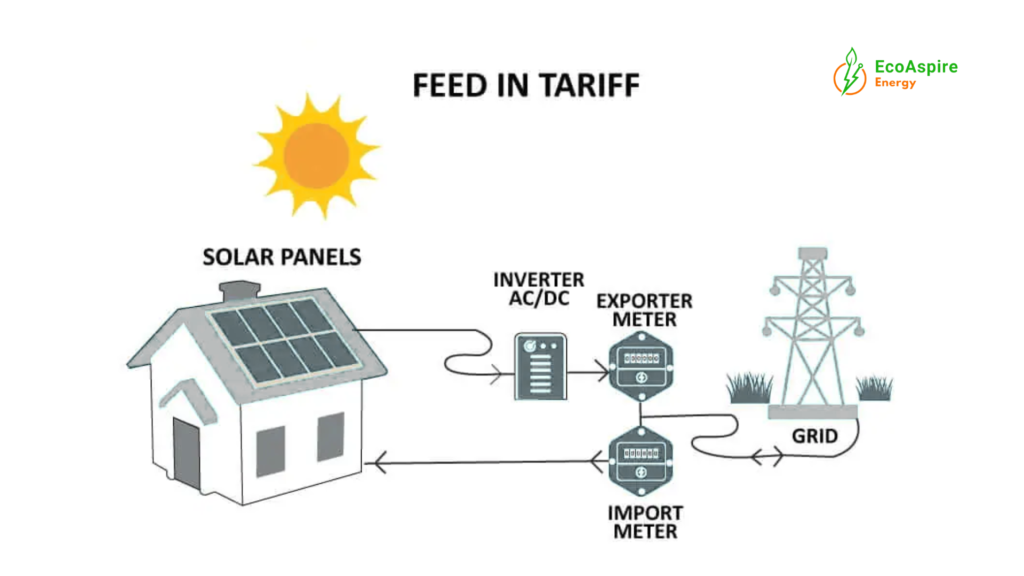
Payments made by electricity retailers to owners of solar panels in return for the excess energy they provide via solar systems back into the grid are called feed-in tariffs. The feed-in tariff system for solar energy offers an incentive for the generation of renewable energy; therefore, you can earn money (in the form of credits) for your investment in a solar system while at the same time reducing your household’s electricity cost.
In Australia, feed-in tariffs vary depending on the state, the retailer and the size of your system so it is important to consider all of the available options when looking to get the best possible return out of a solar investment. So why do I state how important feed-in tariffs are? Because as we move towards a sustainable future, feed-in tariff rates will have a significant effect on the payback period of your solar panels. Higher feed-in tariffs will equate to quicker payback periods of your installation of solar panels making solar a more viable and profitable form of energy for Australian homes.
It’s worth separating two different types of value:
- Self-consumption: Solar you use in your own home offsets electricity you would otherwise buy from the grid (often around 25–40 cents per kWh, depending on your plan and location).
- Exports: Solar you send to the grid is usually paid at a much lower rate (commonly a few cents per kWh).
Why Are Solar Feed-in Tariffs So Low In 2026?
The drop in feed-in tariffs is not a failure of solar. It’s a direct result of how successful rooftop solar has become. Australia now has over 4.22 million PV installations, and that level of adoption creates a predictable pattern: huge solar supply hits the grid at the same time (roughly late morning to mid-afternoon), pushing wholesale electricity prices down. When wholesale prices are low, the market value of exported solar is low, and feed-in credits follow.
In some places, the situation is intensified by network congestion and export constraints. Distribution networks are increasingly managing exports to protect grid stability during periods of high rooftop generation.
Typical Solar Feed-in Tariff Rates In Australia
Feed-in tariff rates vary by state, retailer, and plan, and they change frequently. In 2026, most standard feed-in tariffs sit somewhere around 3 to 10 cents per kWh for daytime exports, with occasional higher “headline” offers that come with trade-offs elsewhere in the plan.
The important takeaway is this: comparing feed-in tariffs alone is rarely a good way to choose an electricity plan. The biggest benefit of solar comes from self-consumption, not exports.
Feed-in tariffs by state
As we become more entrenched in a renewable energy-based model, Feed-In Tariff Rates in 2026 are expected to be market-based, as they are currently, but at a lower rate than previous premium rates. With record levels of rooftop solar installations, a saturated network in daylight hours, and new energy reforms, how Australians earn from their solar energy is continuing to shift.
In 2026, we are expecting to see less focus on high export rates, as we have today, and more focus on smart self-consumption, smart exporting, and battery storage.
At Eco Aspire Energy, we assist in making sense of how these changes impact actual savings, not just feed-in tariff rates.
New South Wales (NSW)
NSW has closed its premium Solar Bonus Scheme for new applicants since 2011. Most households now enjoy market-based feed-in tariffs offered by their retailers.
If you need a benchmark or a reference point, IPART provides a solar feed-in tariff benchmark range, which most retailers follow. However, NSW’s rate falls within the mid-single digits, but it depends on your structure and retailer.
Queensland (QLD)
Queensland’s premium 44 cent Solar Bonus Scheme is no longer open to new customers. Existing legacy customers who were eligible to join the scheme early in the program tend to continue to receive the scheme rate (if they continue to qualify) until 1 July 2028.
For all other customers, the feed-in tariffs in Queensland are market-based. The Queensland Competition Authority (QCA) releases benchmark information that can assist in evaluating whether an offer from a retailer is reasonable.
We spoke to the Energy Solution Centre, a solar retailer based on the Gold Coast, about the response of their customers to the reduction in feed-in tariffs. Their assessment is that the most common question their customers ask them now is whether solar is still worthwhile without the 44 cent feed-in tariff.
Their response to that question is always affirmative, but the circumstances have changed from those of a decade ago. For households that can change their energy use to daylight hours, the payback is often driven by the savings, not the feed-in tariff.
Victoria (VIC)
Victoria’s premium feed-in tariff schemes were closed in 2011. In the past, there was a regulated minimum feed-in tariff in Victoria. However, the Essential Services Commission (ESC) states that there is no minimum feed-in tariff from 1 July 2025, and retailers can charge their own rates.
Victorian households continue to receive low market-based export credits, with the potential for higher rates under specific conditions with their retailers.
South Australia (SA)
South Australia phased out its premium feed-in tariff in 2013. The current feed-in tariffs are market-based.
SA also has very high levels of rooftop solar, which means that the value of daytime exports is often less than what many households would expect. On the other hand, the retail price of electricity in SA makes self-consumption very attractive.
Western Australia (WA)
WA operates differently to the eastern states because its main grid is not part of the National Electricity Market.
For many households, export credits fall under Synergy’s Distributed Energy Buyback Scheme (DEBS), which replaced the older Renewable Energy Buyback Scheme (REBS) for eligible new and upgraded systems.
Solar Feed-In Tariff Comparison Table 2026
Estimated market ranges based on current regulations, retailer trends, and energy policy direction
State / Territory | Expected FiT Range (2026) | System Type | Key Notes |
New South Wales (NSW) | 4c – 15c/kWh | Market-based | Time-of-export tariffs expected to expand |
Queensland (QLD) | 2c – 14c/kWh | Market-based | Legacy 44c scheme ends for most by 2028 |
Victoria (VIC) | 0.5c – 10c/kWh | Market-based | No minimum FiT from July 2025 onward |
South Australia (SA) | 3c – 12c/kWh | Market-based | High solar penetration reduces daytime value |
Western Australia (WA) | 2c – 10c/kWh | DEBS (Synergy) | Time-based export pricing continues |
ACT | 6c – 15c/kWh | Market-based | Competitive retailer FiT plans |
⚠️ Important: Higher FiT rates often come with higher usage charges or export limits. Always assess the total bill impact, not just the feed-in rate.
What’s Changing Next: Export Limits And “Two-Way Pricing”
One of the emerging trends in Australia is that networks are becoming more active in how they manage rooftop solar exports. This can take different forms:
- Export limits: some systems are capped in how much they can send to the grid at once.
- Time-based export value: higher value for exports during late afternoon/evening, lower value at midday.
- Two-way pricing proposals: in some regions, export charges may be proposed to manage congestion during peak solar hours.
The Australian Energy Regulator’s Export Tariff Guidelines explain how networks must justify any future proposals for two-way pricing, and the concept of a basic export level that should remain available for solar customers.
This doesn’t mean solar is becoming “bad”. It means the grid is adapting to a world where households are both consumers and generators. The most future-proof approach is still the same: use more of your solar at home and treat exports as a bonus.
How To Secure the Best Feed-In Tariff Rates in Australia
To lock in the best solar feed-in tariff rates, follow these steps:
- Research Retailers: Compare offers from major providers. Look for contracts that guarantee feed-in tariff rates for 5-10 years.
- Leverage Solar Rebates: Combine feed-in tariff rates with federal solar rebates under the SRES, which can add up to $4,000 for solar battery systems.
- Choose the Right System Size: Larger solar systems (e.g., 5-10kW) often qualify for better feed-in tariff rates, especially in high-demand areas.
- Consult Experts: At Eco Aspire Energy, we specialize in helping Australians navigate feed-in tariff rates and renewable energy incentives. Contact us for personalized advice on the best solar feed-in tariff rates for your location.
Remember, feed-in tariff rates are not guaranteed forever—many contracts have degression clauses that reduce rates over time. Opt for fixed-rate agreements to secure the best solar feed-in tariff rates long-term.
Benefits of High Feed-In Tariff Rates for Australian Solar Owners
Investing in solar with favorable feed-in tariff rates offers numerous advantages:
- Financial Savings: Earn extra income from excess solar energy, potentially offsetting your electricity costs by 20-50%.
- Environmental Impact: Contribute to Australia’s renewable energy goals, reducing carbon emissions.
- Energy Independence: With rising electricity prices, high feed-in tariff rates provide a hedge against inflation.
- Property Value Boost: Homes with solar systems and strong feed-in tariff rates often sell faster and for more.
By choosing the best solar feed-in tariff rates in 2026, you’re not just saving money—you’re investing in a sustainable future.
Conclusion
As Australia continues to transition towards renewable energy, the best solar feed-in tariff rates for 2026 offer a golden chance to go solar. Whether you are in Queensland with the highest feed-in tariff rates or looking for options elsewhere, it is vital to understand feed-in tariff rates to get the most out of your solar investment.
At Eco Aspire Energy, we are here to help you with every step of your solar journey, from choosing the right solar panels to helping you get the highest feed-in tariff rates.
Ready to tap into the power of the sun? Get a free consultation with Eco Aspire Energy on feed-in tariff rates and solar installations. Stay updated on the latest solar feed-in tariff rate news with our newsletter. Join us as we create a brighter, greener Australia!
Disclaimer: Feed-in tariff rates are subject to change based on government policies and market conditions. This post is based on projections from authentic sources like ARENA and state energy regulators as of 2024. Always verify current rates with official channels.