

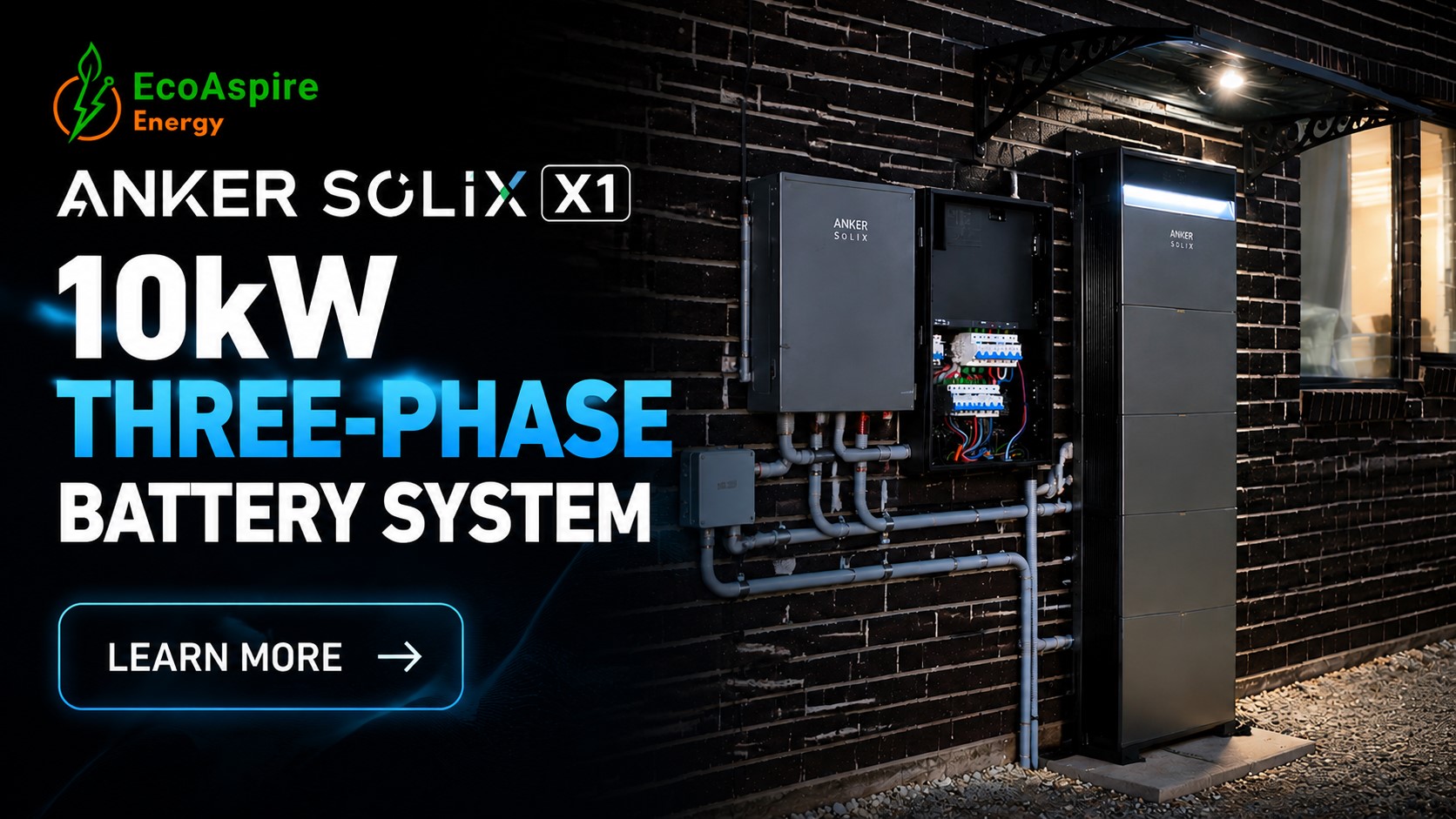
There’s a moment on every solar-and-battery install where the finished product either looks like an afterthought bolted to the wall, or like it was designed to be there. The system pictured in this article — an Anker SOLIX X1 stack paired with a 10kW three-phase hybrid inverter and a dedicated backup switchboard — is very much the latter. It’s a clean example of what a modern, whole-home energy storage system looks like when the hardware, the software, and the installation all pull in the same direction.
Table of Contents
ToggleWhat's Actually in This System
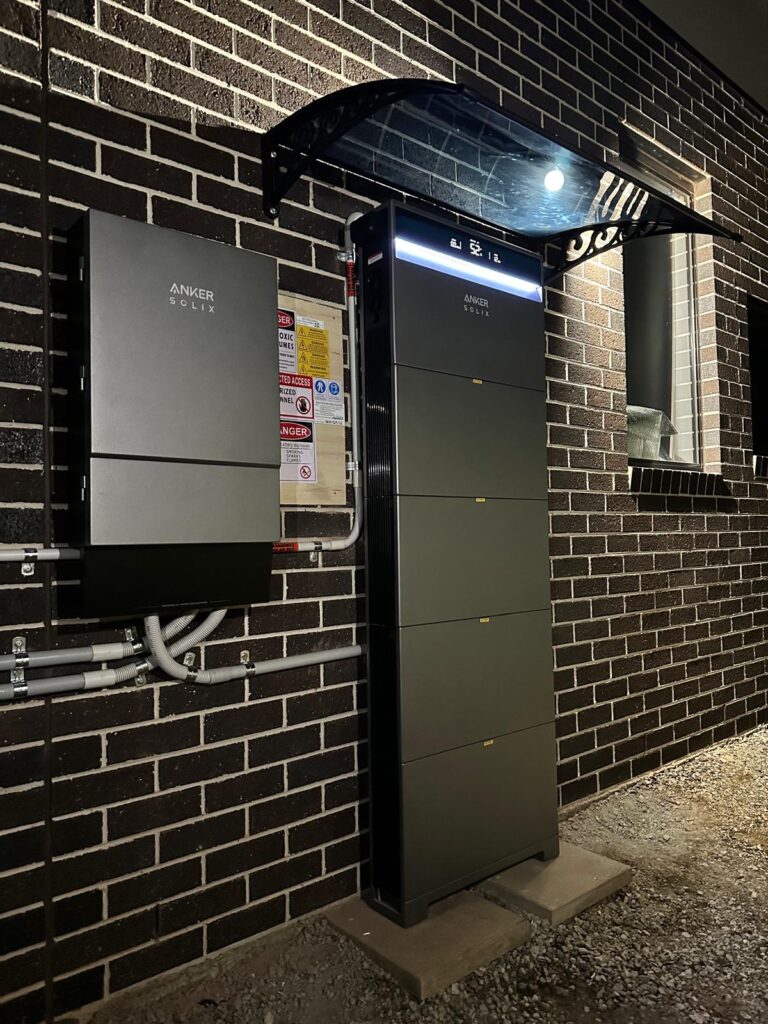
Looking at the install:
- A wall-mounted hybrid inverter/switch unit (the grey box on the left) handling the DC/AC conversion and system control.
- A five-module Anker SOLIX X1 battery stack, lit by its status strip, mounted on a concrete plinth beside the building.
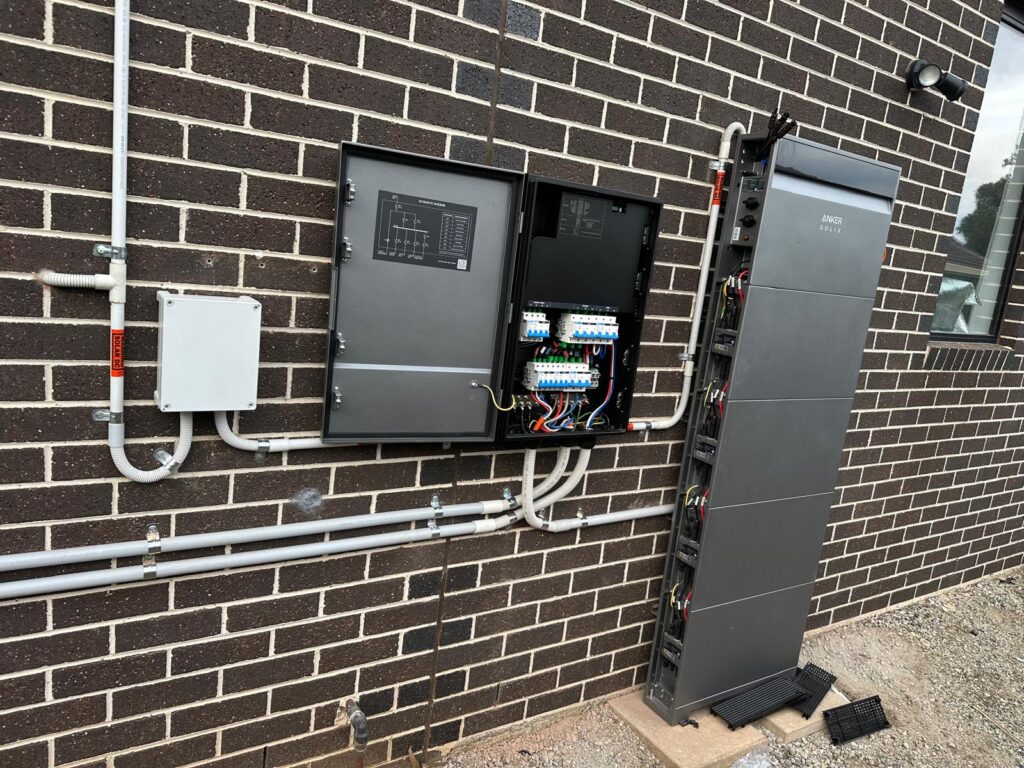
- A dedicated backup and metering switchboard (seen open in the wiring photos), housing the breakers, isolators, and monitoring hardware that tie the battery into the home’s circuits.
- Weatherproof conduit runs and a polycarbonate awning, both signs of an installation built to spend its life outdoors.
This is Anker’s SOLIX X1 Energy Storage System — a modular LFP (lithium iron phosphate) battery platform that pairs 5kWh battery modules with a choice of single- or three-phase hybrid inverters, in this case the 10kW three-phase variant.
Why the 10kW Three-Phase Inverter Matters
A lot of home battery systems on the market are single-phase only, which is fine for smaller homes but becomes a real limitation the moment a property has three-phase power — think larger homes, homes with ducted air conditioning, EV chargers, or workshops. The X1’s three-phase inverter lineup (5kW, 8kW, 10kW, and 12kW options) means the system can balance load and inject or draw power evenly across all three phases, rather than forcing an electrician to juggle loads onto a single phase or install phase-balancing workarounds.
At 10kW, this particular inverter is sized to run genuinely heavy household or light-commercial loads — reverse-cycle ducted air con, pool pumps, EV charging, and general appliance load — directly from stored solar, without the export/import penalties that come from undersized inverters.
A few technical details are worth calling out because they directly affect reliability in the field:
- Full-power operation across a wide temperature band. The X1 is rated to run at full output from roughly -20°C to 50°C without derating, which is unusually wide for a battery system and matters for units mounted outdoors, like the one shown here, exposed to direct sun and cold nights alike.
- IP66-rated hybrid enclosure and C5-M anti-corrosion rating, i.e. built for coastal and harsh-weather exposure rather than a garage-only product.
- Sub-20ms backup switchover, fast enough that most household electronics don’t register the transition when the grid drops.
- Modular scaling — this stack can grow from its current capacity up to 180kWh / 36kW by adding more 5kWh modules or paralleling additional stacks, without replacing the inverter.
The Backup Switchboard: Where Whole-Home Protection Actually Happens
The open switchboard in these photos is what turns a battery into a whole-home backup system rather than just a big power bank. This is where Anker’s backup and load-management hardware — the same category of product as Anker’s SOLIX Power Dock in other regions — sits between the grid, the inverter, and the home’s circuits. It’s the component that automatically islands the property from the grid during an outage and routes stored battery power to the connected circuits, then switches back seamlessly once grid power returns.
Two things stand out in the way this has been installed:
- A labelled schematic diagram inside the cabinet door — a small detail, but one that matters enormously for future servicing, insurance, and compliance sign-off.
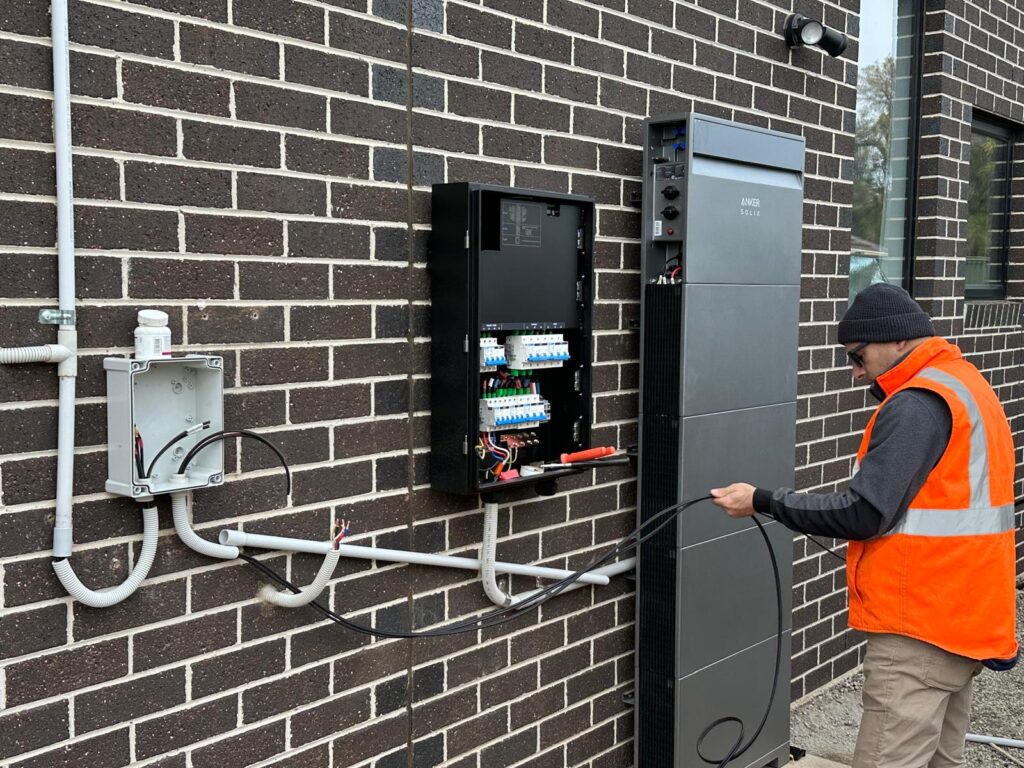
- Clean separation of DC battery wiring, AC switching, and communication cabling, which keeps fault-finding simple and reduces the risk of nuisance trips.
How This Compares to Other Home Battery Systems
No system is automatically “best” for every property, so it’s worth being specific about where the X1 tends to pull ahead of common alternatives, and where the trade-offs sit.
Where the X1 tends to lead
- Three-phase availability up to 12kW — many popular residential battery brands top out at single-phase inverters, or require a separate three-phase-capable inverter sold and warrantied separately.
- Modular, stackable capacity — growing the system later (5kWh → 180kWh) is a matter of adding modules to the existing inverter, rather than replacing hardware.
- Environmental tolerance — the -20°C to 50°C full-power rating and C5-M corrosion resistance are genuinely strong specs for an outdoor-mounted unit, ahead of what many competing systems publish.
- Fast, genuine whole-home switchover, rather than backup limited to a handful of “essential circuit” loads on some competing systems.
- App and monitoring quality — Anker’s consumer electronics background shows up in a polished, well-reviewed monitoring app with tariff scheduling and smart-home integration.
Where buyers should weigh the trade-offs
- Price — three-phase, high-capacity Anker systems generally sit above budget-tier alternatives (for example, comparably sized Fox ESS systems), reflecting the build quality and backup performance on offer.
- Brand track record in stationary storage — Anker is a newer entrant to home battery storage compared with players who’ve been in the stationary energy market for over a decade, even though its consumer power-electronics pedigree is well established.
- Regional availability of accessories — some whole-home backup accessories are rolled out region-by-region, so it’s worth confirming exactly which backup hardware is available and certified in your market before specifying a system.
The Bottom Line
What makes this installation a good showcase isn’t just the Anker branding — it’s the combination of a three-phase inverter with real headroom (10kW), a battery platform that can keep scaling without a hardware swap, and a backup switchboard built and labelled properly for the long term. For a property with three-phase supply, heavier daily loads, or plans to add an EV charger down the track, that combination is hard to match at this price point, and it’s a big part of why the X1 has quickly become a reference point other three-phase battery systems are compared against.