
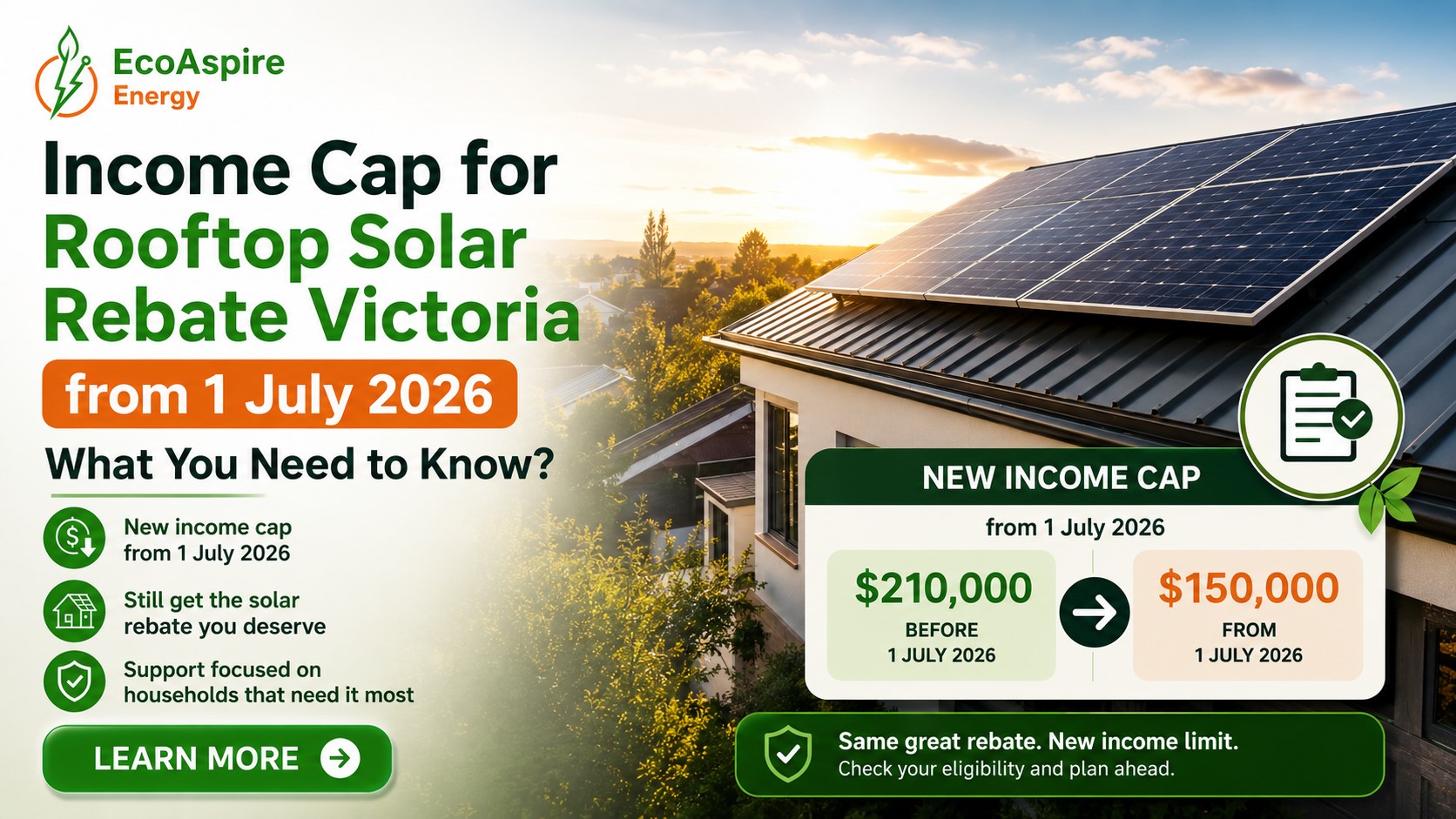
If you’re a Victorian homeowner thinking about going solar, there’s an important change coming that could affect whether you qualify for a government rebate. From 1 July 2026, the Victoria solar rebate income cap is dropping from $210,000 to $150,000 per year for combined household taxable income.
Table of Contents
ToggleThis change applies to the Solar Homes Program, run by Solar Victoria, which has helped hundreds of thousands of households across the state install rooftop solar panels and energy-efficient hot water systems since it began in 2018.
If your household income sits between $150,000 and $210,000, this is genuinely time-sensitive information. Below, we break down exactly what’s changing, who it affects, and what you need to do before the deadline.
Many homeowners are now asking questions such as:
- Am I still eligible?
- Has the rebate amount changed?
- Why did the government reduce the income limit?
- Can I still receive an interest-free loan?
- Is now the right time to install solar?
This guide answers all of these questions using information from official Victorian Government sources. At Eco Aspire Energy, we help homeowners across Victoria understand the latest solar rebate rules and install high-quality solar systems that deliver long-term savings.
What Is Changing From 1 July 2026?
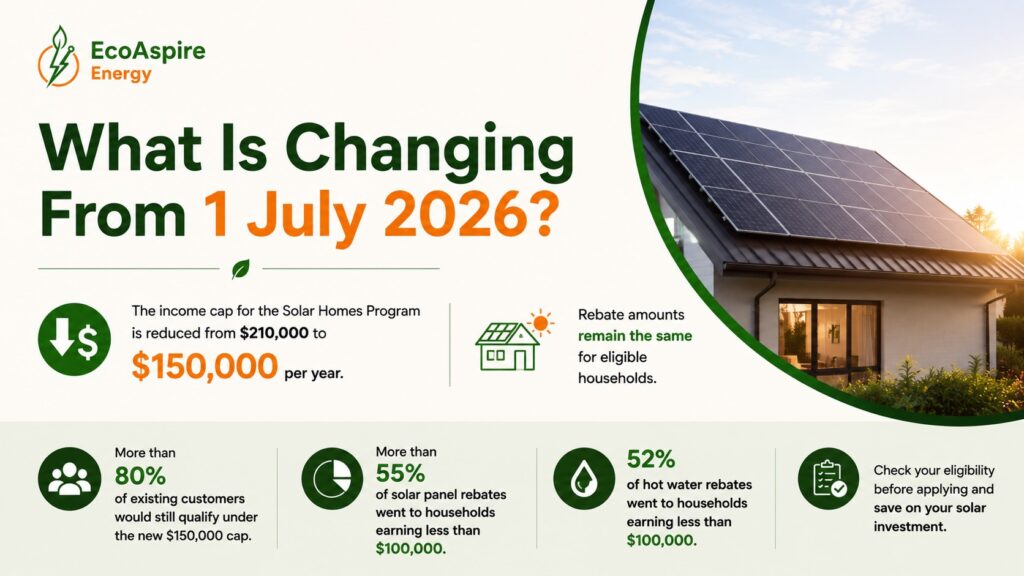
From 1 July 2026, the Victorian Government has introduced a new income cap for the Solar Homes Program. The combined household taxable income limit for the Solar Panel (PV) Rebate (including both owner-occupied and rental properties) and eligible hot water rebates has been reduced from $210,000 to $150,000 per year.
This update changes who can apply for the rebates, but it does not reduce the rebate amount available to eligible households. Homeowners and landlords who meet the new income threshold and all other program requirements can still receive financial assistance to help lower the upfront cost of installing rooftop solar or upgrading to an eligible hot water system.
The Victorian Government has stated that the revised income limit is designed to ensure the Solar Homes Program continues to provide support to households that need it most. According to program data, more than 80% of existing Solar Homes customers would still qualify under the new $150,000 income cap.
Government figures also show that the majority of rebate recipients have historically been lower- to middle-income households. More than 55% of Solar Panel (PV) rebates and 52% of hot water rebates have been provided to Victorian households with a combined annual income of less than $100,000. These figures indicate that most past applicants would continue to meet the updated eligibility requirements.
For homeowners planning to install solar in Victoria, it’s important to check your eligibility before applying. If your combined household taxable income is $150,000 or less, you may still be able to access the Solar Homes rebate and reduce the cost of your renewable energy investment.
Quick Overview of the New Income Cap
Before 1 July 2026 | From 1 July 2026 |
Household income up to $210,000 | Household income up to $150,000 |
Eligible for Solar Homes Rebate | Eligible if income is $150,000 or less |
Rebate available | Rebate still available |
Interest-free loan available | Interest-free loan still available |
As you can see, only the income eligibility has changed. The financial support available under the Solar Homes Program remains the same for eligible households.
Why Did the Victorian Government Reduce the Income Cap?
The Victorian Government reviewed how the Solar Homes Program has been supporting homeowners over recent years. According to Solar Victoria, most households that previously received rebates had annual incomes below the new threshold. Government data showed that:
- More than 80% of previous applicants would still qualify under the new income cap.
- More than half of all successful applicants earned less than $100,000 per year.
Based on this data, the Government decided to reduce the maximum household income from $210,000 to $150,000 so rebate funding could be directed toward households that may benefit most from financial assistance. The aim is to continue supporting renewable energy adoption while ensuring public funding is used where it can have the greatest impact.
Who Is Eligible for the New Victoria Solar Rebate?
Although the income cap for the rooftop solar rebate in Victoria changed from 1 July 2026, most of the Solar Homes Program eligibility requirements remain the same. The main difference is that the combined household taxable income limit has been reduced from $210,000 to $150,000 per year.
Below is a complete overview of the current eligibility requirements for homeowners and landlords applying for the Victorian Solar Homes rebate.
1. You Must Own the Property:
To apply for the Solar Panel (PV) Rebate, you generally need to be the owner-occupier of the property where the solar system will be installed. If your home is still under construction, you may be able to apply during the building process, provided you meet the program requirements. The solar installation can usually be completed after construction is finished and you have moved into the property.
For hot water rebates, the property must normally be fully completed and occupied before the installation takes place. Landlords cannot apply through the owner-occupier rebate. Instead, they must apply under the Solar for Rental Properties program if their property meets the eligibility requirements.
2. Combined Household Income Must Be $150,000 or Less
The biggest change introduced from 1 July 2026 is the new income threshold. To qualify for the Solar Homes rebate, the combined taxable income of all property owners listed on the title or council rates notice must be $150,000 or less per financial year.
Applicants will need to provide income documents for each eligible owner using information from the same financial year. If the combined income exceeds the new limit, the application may not qualify for the rebate.
3. Property Value Must Be Below $3 Million
Your property’s value must be less than $3 million. This requirement applies to both existing homes and newly built homes. For homes under construction, the estimated value once construction is complete is generally used when assessing eligibility. The property value limit helps ensure government rebates are directed towards typical Victorian households.
4. The Property Must Not Have Previously Received the Same Rebate
Solar Homes rebates are linked to the property address, not the homeowner. If a previous owner has already claimed a Solar Panel (PV) Rebate for that address, the property is generally not eligible to receive the same rebate again.
The same rule also applies to hot water rebates. Before purchasing a property, it is worth checking whether the address has previously received assistance under the Solar Homes Program.
5. Existing System Requirements
If your home already has a solar system, you may still qualify in certain situations. Generally, homes with a solar PV system installed more than 10 years ago may be eligible for replacement or system upgrades, subject to Solar Victoria’s current program rules. For hot water rebates, the existing hot water system is generally expected to be at least three years old before replacement is considered.
6. Moving to a New Home
Receiving a Solar Homes rebate at a previous address does not automatically prevent you from applying again. If you move to another primary residence, you may still be eligible to apply, provided the new property has not already received the same rebate and all other eligibility requirements are met. This allows homeowners to continue benefiting from the program when relocating within Victoria
7. Use an Approved Solar Retailer
To receive the rebate, your solar installation must be completed by a Solar Victoria-authorised retailer using products that appear on Solar Victoria’s approved product lists. Choosing an authorised installer is essential because installations completed by non-approved retailers generally do not qualify for government rebates.
At Eco Aspire Energy, we can guide you through the rebate process and help ensure your installation meets all current Solar Victoria requirements.
Who Will Be Affected?
The new income cap for the rooftop solar rebate in Victoria mainly affects households with a combined taxable income between $150,000 and $210,000 per year. These households may have qualified for the Solar Homes rebate before 1 July 2026, but they are no longer eligible under the updated income limit. Homeowners with a combined household income of $150,000 or less can still apply for the rebate if they meet all other Solar Victoria eligibility requirements.
The change is expected to have a limited impact on most applicants. According to the Victorian Government, more than 80% of previous Solar Homes customers would still qualify under the new $150,000 income cap, as many rebate recipients have historically earned below this threshold.
If you’re unsure whether you qualify under the new rules, Eco Aspire Energy can help you check your eligibility and guide you through the rebate application process.
How to Apply for the Victoria Solar Homes Rebate: Step-by-Step Guide
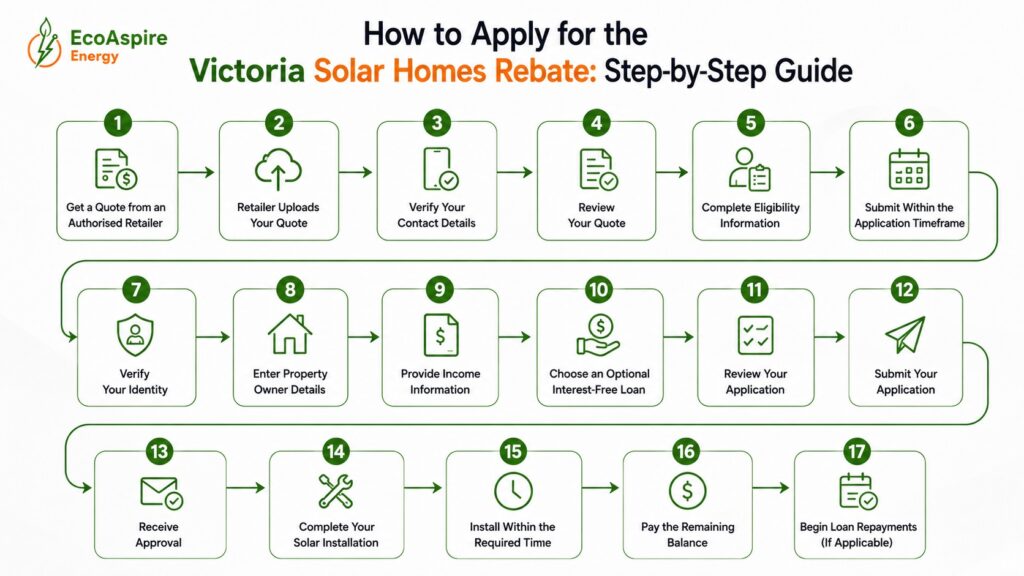
Applying for the Victoria Solar Homes Rebate is simple when you work with an authorised solar retailer. Follow these steps to complete your application successfully.
Step 1: Get a Quote from an Authorised Retailer
Start by requesting a quote from a Solar Victoria-authorised retailer, such as Eco Aspire Energy. Your rebate application cannot begin until you have accepted a quote from an approved retailer.
Step 2: Retailer Uploads Your Quote
Once you accept the quote, your retailer will upload your project details to the Solar Victoria portal. After this is completed, you’ll receive an email from Solar Victoria with a link to continue your application.
Step 3: Verify Your Contact Details
Open the email, access the application portal, and verify your email address and mobile number using the one-time security code sent to your phone.
Step 4: Review Your Quote
Check that your quote, property address, system details, and rebate type are correct. If you notice any errors, contact your retailer before proceeding.
Step 5: Complete Eligibility Information
Answer the required eligibility questions, including property ownership, household income, and previous rebate history. Hot water applicants replacing a failed system may also need to indicate an emergency installation.
Step 6: Submit Within the Application Timeframe
Once your application has started, complete and submit it within the required timeframe. Incomplete applications may lose their reserved rebate allocation.
Step 7: Verify Your Identity
Provide the required identification documents or sign in using your Service Victoria account to verify your identity.
Step 8: Enter Property Owner Details
Add the details of every property owner exactly as they appear on official documents. Returning applicants may have fewer details to provide.
Step 9: Provide Income Information
Upload proof of combined household taxable income if required. Returning applicants may only need to confirm they still meet the current income eligibility requirements.
Step 10: Choose an Optional Interest-Free Loan
If you’re applying for a solar panel rebate, you can choose to apply for the optional interest-free loan during the application process.
Step 11: Review Your Application
Carefully review all information before submitting. Correct any mistakes to avoid delays in processing your application.
Step 12: Submit Your Application
Accept the declarations and formally submit your application through the Solar Victoria portal.
Step 13: Receive Approval
If your application is approved, Solar Victoria will send you a confirmation email along with a QR code for your installation.
Step 14: Complete Your Solar Installation
Your authorised installer will scan the QR code on installation day before beginning the work. This confirms the installation has been approved.
Step 15: Install Within the Required Time
Your solar system must be installed within the timeframe specified by Solar Victoria after your approval has been issued.
Step 16: Pay the Remaining Balance
The rebate is paid directly to your installer, so you only pay the remaining balance after the rebate has been deducted from the total installation cost.
Step 17: Begin Loan Repayments (If Applicable)
If you selected the optional interest-free loan, repayments will begin automatically according to the agreed repayment schedule after your installation is complete.
Apply Early to Maximise Your Solar Rebate Opportunity
If you submitted a complete Solar Homes application by 5:00 pm on 30 June 2026, and your combined household income was between $150,000 and $210,000, your application could still be assessed under the previous income cap. From 1 July 2026, all new applications are subject to the reduced $150,000 combined household income limit.
Special Exemption for Solstice Energy Customers
Eligible customers affected by the closure of the Solstice Energy CNG network who are switching to electric appliances remain exempt from the new income cap, subject to the Victorian Government’s eligibility requirements.
Victoria's Solar Homes Program Success
Since launching in 2018, the Solar Homes Program has helped increase rooftop solar adoption from around 14% to 30% of suitable Victorian homes. Today, more than 850,000 solar PV systems are installed across Victoria, generating around 10% of the state’s electricity, while over 45,000 households have installed home battery systems.
More Support to Reduce Energy Bills
The Victorian Government continues to invest in clean energy by offering 27,000 additional hot water rebates during the 2026–27 financial year. Households can also access discounts through the Victorian Energy Upgrades (VEU) program, use Victorian Energy Compare to find better energy plans, and receive support through the Energy Assistance Program. From 1 October 2026, eligible households that opt in to the Victorian Midday Power Saver will receive up to three hours of free electricity during the middle of the day, helping reduce energy bills even further.
Need Help Applying?
Applying for the Victorian Solar Homes rebate doesn’t have to be complicated. At Eco Aspire Energy, our experienced team helps homeowners across Victoria understand the latest rebate requirements, prepare the necessary documents, and install high-quality solar systems that meet Solar Victoria’s standards.
When you choose Eco Aspire Energy, you receive:
- Free consultation and system assessment
- Tailored solar solutions for your home
- High-quality solar panels and inverters
- Professional installation by experienced technicians
- Assistance with Solar Victoria rebate applications
- Transparent pricing with no hidden surprises
- Friendly after-sales support
From your first quote to final installation, we’re here to make your transition to clean, affordable solar energy as simple as possible.