
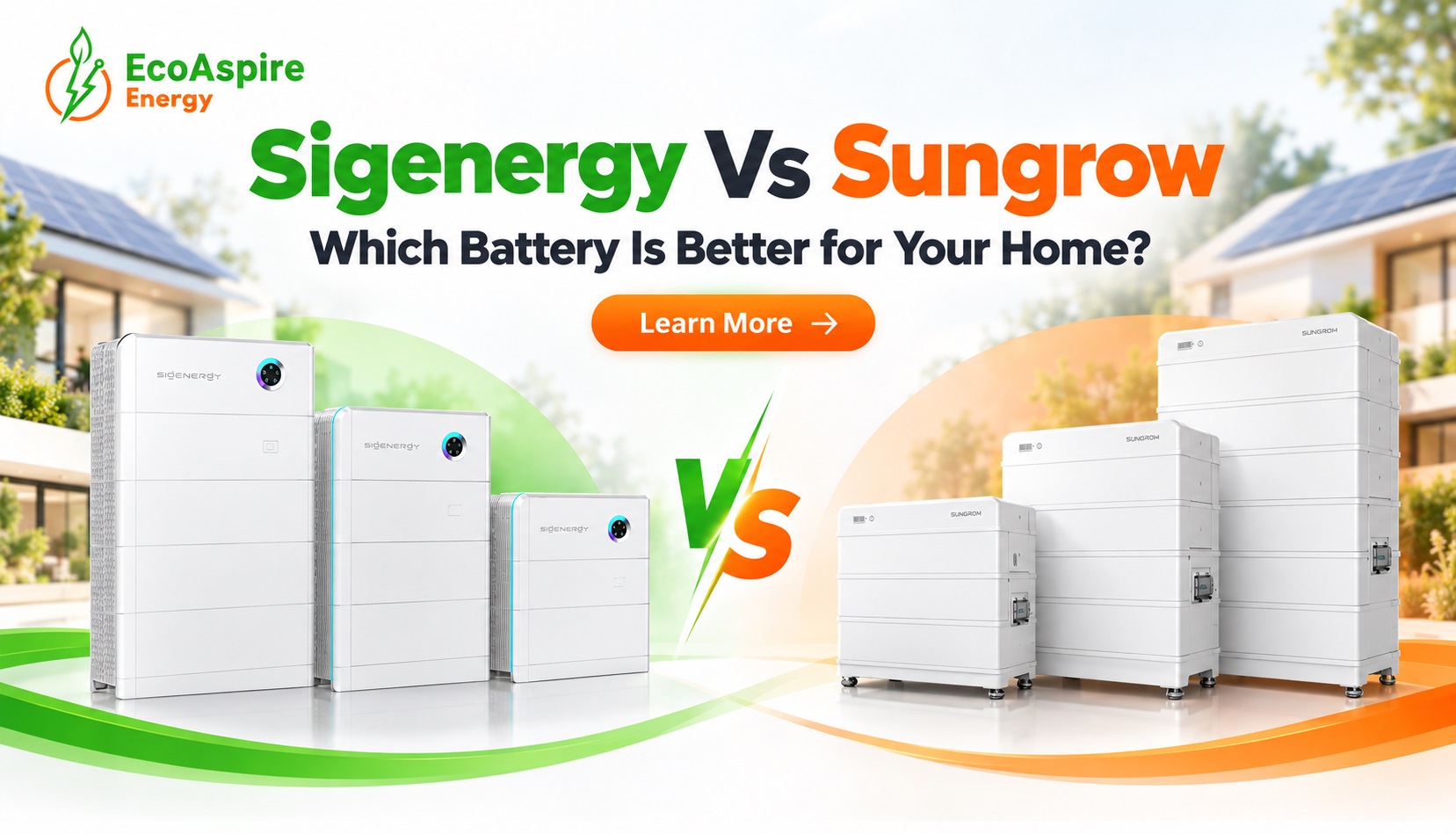
Two names keep coming up when Victorian homeowners compare battery brands in 2026: Sigenergy and Sungrow. Both are genuinely strong options, but they come from very different places: a newer, feature-packed all-in-one system versus a long-established, proven performer, and the right pick depends more on what you need than on which brand is “better” in the abstract. This Sigenergy Vs Sungrow battery comparison breaks down company background, specifications, warranty terms, and real cost, so you can choose with confidence.
Table of Contents
ToggleAt Eco Aspire Energy, we install both brands across Victorian homes, so this comparison reflects what we actually see in the field, not just spec sheets.
Sigenergy Battery Vs Sungrow Battery: Specifications Compare
| Specification | Sigenergy (SigenStor) | Sungrow (SBR / SBH Series) |
|---|---|---|
| Battery Chemistry | LiFePO₄ (LFP) | LiFePO₄ (LFP) |
| Capacity Range | Modular capacity from 5 kWh up to 48 kWh | SBR: 6.4–25.6 kWh SBH: 15 kWh+ scalable system (multiple units can be combined for larger capacity) |
| Design Type | All-in-one energy system combining inverter, battery, EMS, and EV charging capability | Modular battery system paired with a separate Sungrow hybrid inverter |
| IP Rating | IP66 (higher protection against dust and water ingress) | IP55 (suitable for protected outdoor installation) |
| Backup Switching | 0 ms UPS-level backup switching (seamless transition) | Automatic backup changeover (switching time depends on system configuration) |
| Battery Life / Performance | Up to 10,000 cycles (manufacturer stated) | SBR: 8,960 kWh throughput per module SBH: 14,000 kWh throughput per module |
| EV Charging Integration | Built-in 25 kW bidirectional EV charging (V2X) capability | No integrated EV charger; requires a separate EV charging solution |
| Warranty | 10-year warranty terms available, but with a shorter Australian market history compared with Sungrow | 10-year product warranty and 10-year performance warranty (subject to capacity retention and throughput conditions) |
| Compatible Inverters | Integrated inverter within the SigenStor all-in-one system | Compatible with Sungrow SH-RS / SH-RT hybrid inverter series |
| Best For | Homeowners looking for an integrated smart energy system, EV integration, and modern all-in-one design | Homeowners wanting a modular battery system with established Australian support and a wide installation base |
Sigenergy Product Overview
Sigenergy is a relative newcomer, founded in China in 2022, but it has expanded into the Australian and international markets remarkably quickly, backed by a leadership and engineering team drawn from established players in the solar and EV industries. The brand’s signature product, SigenStor, is marketed as the world’s first 5-in-1 energy system, combining a solar inverter, EV fast charger, battery power conversion system, battery pack, and smart energy management system into a single unit.
Rather than positioning itself as just another battery manufacturer, Sigenergy has built its entire product around the idea that a modern home’s energy needs, solar generation, storage, EV charging, and grid interaction, should be managed by one intelligent system rather than several separate devices talking to each other imperfectly. The battery pack itself uses LiFePO₄ (LFP) chemistry and scales modularly from 5 kWh up to 48 kWh, so a household can start with a smaller configuration and expand later without replacing the core unit. It’s a bold, tech-forward pitch, and the Sigenergy battery has quickly built a reputation among Victorian homeowners who want the newest features available, particularly those already invested in or planning to buy an electric vehicle.
Advantages:
- True all-in-one simplicity, with inverter, battery, EMS, and EV charger built into a single unit
- Built-in 25 kW bidirectional (V2X) EV charging, native to the system rather than a bolt-on add-on
- Seamless 0ms backup switching during a grid outage
- AI-driven energy optimisation that actively manages charging and discharging
- IP66 outdoor durability rating, the highest of the two brands compared here
Limitations:
- Limited long-term Australian track record, having only entered the market in 2022
- All-in-one design means the inverter and battery can’t be sourced or replaced independently if one component needs servicing
- Premium features like built-in EV charging add less value if you don’t own or plan to own an EV
- Fewer installers currently have deep field experience with the brand compared to more established names
Sungrow Product Overview
Sungrow tells a very different story. Founded in 1997 in Hefei, China, Sungrow is a publicly listed, multi-billion-dollar renewable energy company (Shenzhen Stock Exchange: 300274) best known globally for its solar inverters, which it has manufactured and shipped worldwide for close to three decades, before expanding into battery storage in 2018. Sungrow has operated a dedicated Australian office in North Sydney since 2012, giving the Sungrow battery range a long track record of local support, well ahead of most competitors including Sigenergy.
Sungrow’s residential battery range centres on two product lines built around different household needs. The SBR series is the more common residential choice, a modular LFP battery stacking in 3.2 kWh increments from 6.4 kWh up to 25.6 kWh, designed to pair with Sungrow’s own SH-RS and SH-RT hybrid inverters. For larger homes or higher-demand properties, the SBH series scales further, from 15 kWh up to a combined 160 kWh across multiple units. Rather than chasing the newest feature set, Sungrow’s approach leans on manufacturing scale, a well-documented product line, and a deep installer base built over more than a decade in the Australian market, making the Sungrow battery a common recommendation for homeowners who want dependable performance backed by a long operating history.
Advantages:
- Nearly a decade and a half of proven Australian operating history behind the warranty
- Flexible modular scaling, with the SBR series expanding in small 3.2 kWh increments
- A strong, widely installed hybrid inverter ecosystem (SH-RS and SH-RT series)
- Unified monitoring across compatible Sungrow solar, battery, and EV equipment via the iSolarCloud app
- Competitive value positioning without a top-tier premium brand markup
Limitations:
- Not a true all-in-one system, meaning battery and inverter compatibility needs to be confirmed rather than assumed
- No built-in EV charging functionality, so a separate charger is required if that’s a priority
- Performance warranty guarantees a lower capacity retention threshold (70%) compared to some newer competitors
- Lacks the AI-driven, app-integrated energy optimisation that defines Sigenergy’s pitch
Performance: What Each Battery Is Actually Like to Live With
Sigenergy Battery Performance
The standout feature of the Sigenergy battery is genuine integration. Because the inverter, battery, EMS, and EV charger are built as one unit, there’s no juggling compatibility between separate components from different manufacturers. The AI-powered energy management system actively optimises when to charge, discharge, or draw from the grid based on your usage patterns and, where relevant, electricity pricing. The 0ms backup switching is also a genuine advantage, providing seamless, UPS-level continuity during a grid outage rather than the brief flicker some systems produce during changeover.
Sungrow Battery Performance
The Sungrow battery range prioritises proven reliability over novelty. The SBR series stacks in 3.2 kWh increments from 6.4 kWh up to 25.6 kWh, giving households a genuinely flexible starting point, while the higher-voltage SBH series scales further for larger homes or commercial applications. Sungrow batteries pair with the brand’s widely installed SH-RS and SH-RT hybrid inverters, and monitoring runs through the iSolarCloud app, which also covers compatible Sungrow solar and EV charging equipment in one place. It isn’t as feature-dense as Sigenergy, but it’s dependable, well-documented, and backed by nearly a decade and a half of Australian support history.
Warranty: A Real Point of Difference
This is one area where the Sigenergy Vs Sungrow battery comparison currently favours Sungrow on track record, if not necessarily on paper specifications.
Sungrow’s warranty terms are well-documented and tested in the Australian market: a 10-year product warranty against manufacturing defects, plus a 10-year performance warranty guaranteeing at least 70% capacity retention, capped by a throughput limit (8,960 kWh per module for SBR, 14,000 kWh per module for SBH), whichever comes first for typical household self-consumption and backup use.
Sigenergy’s warranty terms are competitive on paper, but as a brand that only entered the market in 2022, it simply has less real-world Australian claims history behind it than Sungrow. That’s not necessarily a red flag, but it’s a genuine factor worth weighing if long-term warranty certainty matters more to you than having the newest features.
Cost and Rebates for Victorian Homeowners
Both the Sigenergy battery and Sungrow battery ranges are CEC-listed and eligible for the federal Cheaper Home Batteries Program, which applies an upfront discount through Small-scale Technology Certificates (STCs) on the first 50 kWh of usable capacity, no separate claim required, since it’s applied directly at the point of sale by your installer.
As a general guide to where each brand sits in the market:
- Sungrow tends to sit in the mid-to-premium price bracket, reflecting its established local support and proven track record.
- Sigenergy pricing varies more by configuration, since the all-in-one design bundles the inverter, EV charger, and EMS into the unit cost rather than pricing the battery in isolation.
If you’re installing new solar alongside either battery, the Solar Homes Program through Solar Victoria can add a further rebate on the panel component for eligible households. See our full Victoria solar rebates guide for current eligibility and amounts.
Because pricing depends heavily on your specific system size and home, the only reliable way to compare real out-of-pocket cost between a Sigenergy battery and a Sungrow battery for your property is a personalised quote.
Which Should You Choose?
Choose Sigenergy if:
- You want the newest available technology in a single, sleek unit
- You already have or are planning to buy an EV and want built-in bidirectional charging
- You value AI-driven energy optimisation and app-based control
- You’re comfortable with a newer brand that has less long-term Australian track record
Choose Sungrow if:
- You want a proven, extensively tested battery with a long Australian support history
- You prefer a modular system that can start smaller and expand later in defined increments
- You already have or plan to install a Sungrow hybrid inverter
- You’re prioritising long-term reliability and warranty certainty over the newest features
For a broader look at how these two stack up against other brands on the market, our full solar battery comparison covers additional options side by side.
Frequently Asked Questions
Q: Is Sigenergy or Sungrow better for a Victorian home?
A: Neither is universally better. Sungrow suits homeowners prioritising proven reliability and long-term warranty track record, while Sigenergy suits those wanting the newest all-in-one technology, particularly if EV charging integration matters to you.
Q: Can I add an existing solar system to either battery?
A: Sungrow batteries pair with Sungrow’s own hybrid inverter range, so compatibility depends on your existing (or planned) inverter. Sigenergy’s SigenStor is an all-in-one unit, so it typically replaces rather than integrates with an existing separate inverter.
Q: Which battery has a longer track record in Australia?
A: Sungrow, by a significant margin. It entered the battery storage market in 2018 and has run a dedicated Australian office since 2012, while Sigenergy only launched globally in 2022.
Q: Do both batteries qualify for the federal battery rebate?
A: Yes, both the Sigenergy battery and Sungrow battery ranges are CEC-listed and eligible for the Cheaper Home Batteries Program, applied as an upfront discount at the point of sale.
Q: Does Sigenergy’s EV charging feature make it worth the premium?
A: It depends on your household. If you already own or are planning to buy an EV, the built-in bidirectional charging genuinely simplifies your setup and adds real value. If EV charging isn’t on your radar, that feature contributes less to the overall value equation.
Get a Personalised Comparison for Your Home
Reading specs only gets you so far. The right choice in this Sigenergy Vs Sungrow Battery decision depends on your roof, your existing solar setup, your budget, and whether EV charging is part of your plans. Our team installs both the Sigenergy battery and Sungrow battery across Victorian homes, and can walk you through exactly which one fits your property. For a deeper look at either brand individually, see our full Sigenergy review and Sungrow battery review.
Contact Eco Aspire Energy today for a free, no-obligation quote comparing both options for your home.