

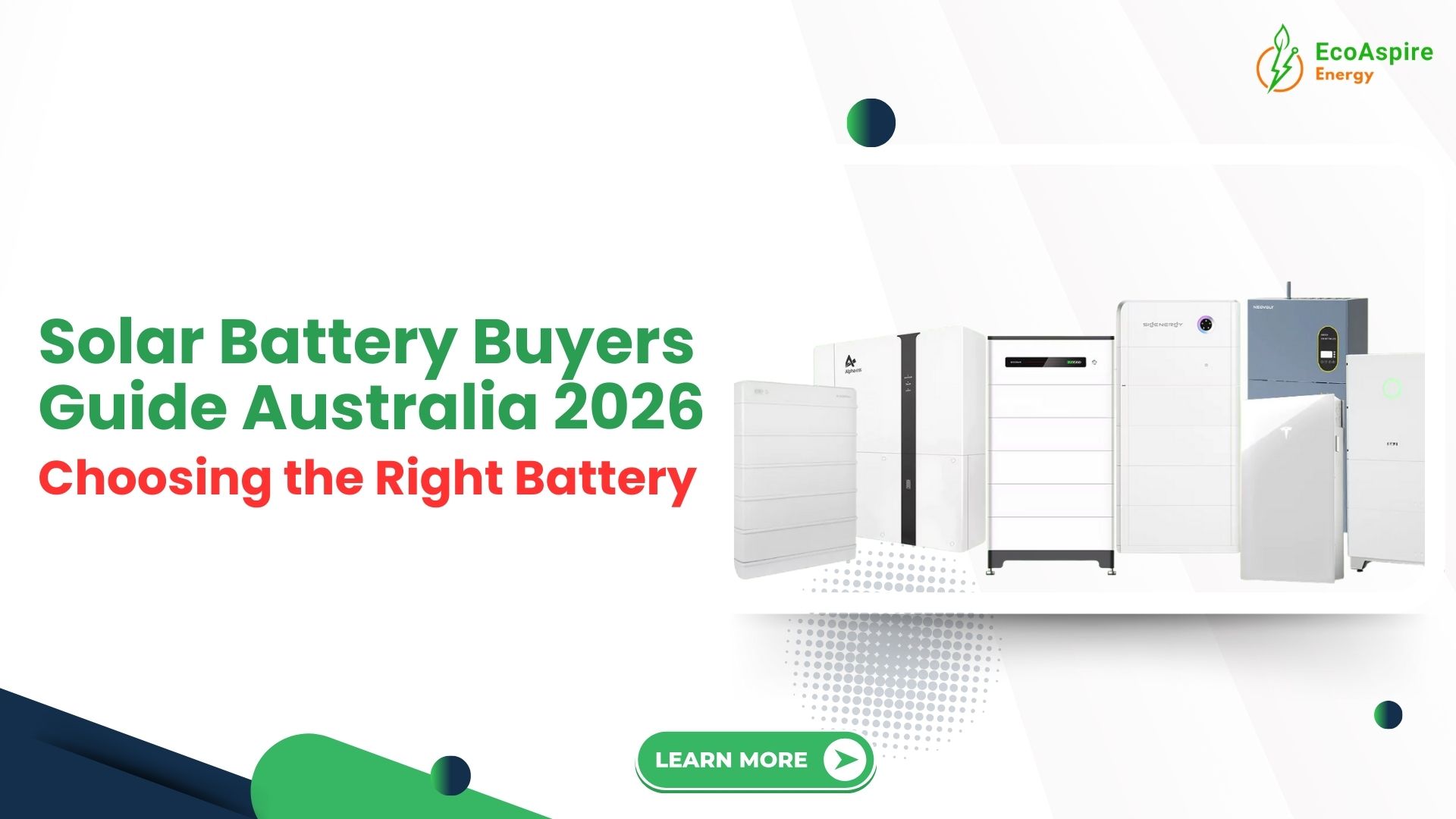
Solar Battery Buyers Guide Australia 2026
With electricity costs rising, many Australian households are seeking a safe, affordable path to energy independence. This Solar Battery Buyers Guide for 2026 explains exactly how to store the sun’s energy and when to use it to maximise savings.
Table of Contents
ToggleWhether you are new to solar or retrofitting a battery to an existing system, this guide simplifies which battery technology is best for you, how to size it correctly, and how to ensure safe installation.
Solar Battery Buyers Guide 2026: A Simple Solution
With electricity costs rising and grid-connected power prices also rising, using batteries at home is now a smart decision, according to the Solar Battery Buyers Guide 2026.
It stores solar energy from the sun to power your home at night or when there is no power, reducing your electricity bill and reducing your dependence on the grid.
Your home’s solar panels generate electricity during the day. This electricity is used by all your home appliances first, and the rest is stored in the battery. This energy can be used at night or when there is no sun. If you are looking to install a new system or add batteries to an old system, this guide explains in simple terms which batteries and systems are best for you.
How It Works
Generation: Solar panels generate electricity during the day.
Consumption: Your home appliances use this power first.
Storage: Any excess energy charges your battery.
Usage: You draw from the battery at night or when the sun isn’t shining.
What is a Solar Battery Storage System?
A solar battery system works in tandem with your rooftop panels to store energy for later use. It is the critical component for reducing grid dependence and achieving “off-grid” capabilities in an urban setting.
System Components
Solar Panels: The power generator.
Batteries (e.g., Tesla Powerwall, BYD): The storage unit for excess energy.
Inverter (Hybrid or Separate): Converts DC electricity (from panels/battery) to AC electricity (for home appliances).
Monitoring System: An app or portal to track usage and generation in real-time.
Key Benefits
Slash Evening Bills: Use stored solar power when rates are highest.
Blackout Protection: Keep lights and fridges running during power outages.
Avoid TOU Costs: dodge high “Time-of-Use” tariffs by relying on your battery during peak windows.
Are Solar Batteries Safe in 2026?
Yes. When installed correctly, modern solar batteries are exceptionally safe. The industry has moved past the concerns of earlier lithium models.
Why modern systems are safe:
Chemistry: Most new batteries use Lithium Iron Phosphate (LiFePO₄), which has a much higher thermal stability and lower fire risk than older chemistries.
BMS: Advanced Battery Management Systems automatically shut down the unit if overheating is detected.
Standards: Strict adherence to AS/NZS 5139 installation standards ensures batteries are installed in safe, fire-proofed locations.
Although there have been some battery recalls in the past (such as the 2017–2018 LG and SolaX models), these incidents are very rare. There have been over 200,000 home battery systems installed in Australia and the ACCC reports very few safety issues.
Things to remember to ensure battery safety
- Choose a trusted battery brand: Use batteries that are supported in Australia and have good reviews. We provide a list of “trusted solar battery brands in Australia” here, which will help you choose a safe and long-lasting battery brand.
- Use CEC-approved solar products: Always use CEC-approved solar products for proper and safe installation.
- Keep the area around the battery clean and safe: Keep the area around the battery clean, dry and well-ventilated.
- For additional safety: Read our solar battery safety guide for homeowners to learn about fire hazards, safety ratings, insurance and emergency preparedness and learn complete safety tips.
Why Invest in Solar Battery Storage?
Beyond safety, a battery gives you control.
Arbitrage Savings: Charge when energy is cheap (or free from the sun) and discharge when the grid charges $0.70/kWh or more.
Energy Security: Maintain power during storms or grid failures.
Maximise Self-Consumption: Stop selling your solar for a low feed-in tariff (e.g., 5c/kWh) and start using it to offset high import rates.
VPP Income: Join a Virtual Power Plant to earn credits for supporting the grid.
Popular Solar Battery Brands in Australia (2026)
Choosing the right brand is about balancing capacity, chemistry, and warranty.
| Brand | Battery Type | Capacity | Warranty | Origin | Notes |
| Tesla | NMC | 13.5 kWh | 10 Years | USA | High brand value, sleek design. |
| Alpha ESS | LiFePO₄ | 10.1 kWh | 10 Years | China | Great value, integrated options. |
| Sigenergy | LiFePO₄ | 16 kWh | 10 Years | China | Modular AI-driven system. |
| Enphase | LiFePO₄ | 10 kWh | 15 Years | USA | Excellent for microinverter systems. |
| BYD | LiFePO₄ | 13.8 kWh | 10 Years | China | Modular stackable design. |
How to Choose the Right Size
Don’t buy the biggest battery just because you can. A battery that is too large will never fully charge, wasting your money. One that is too small won’t get you through the night.
| Family Size | Daily Usage | Recommended Battery |
| 1–2 People | 10–15 kWh | 5-13 kWh |
| 3–4 People | 15–25 kWh | 15–25 kWh |
| 5+ People | 25+ kWh | 30–40+ kWh |
Financial Analysis: Are They Profitable?
In 2026, the combination of lower hardware costs and government rebates makes batteries a smart investment.
Example Scenario (2026 Estimate)
System: 13.3 kW Solar + 41.3 kWh Battery
Upfront Cost: ~$27,299
Federal Rebate: -$7,838 (~$350/kWh)
Net Cost: ~$10,500 (excl. VAT)
Annual Savings: $1,800 – $2,300
Payback Period: 5–7 Years
Note: Residents in Vic may access an additional $8,800 interest-free loan, potentially dropping the payback period to under 5 years.
Types of Solar Battery Technology
| Battery Type | Safety | Lifespan | Cost | Best For |
| LiFePO₄ | High | 10–15 Yrs | Medium | Long-term safety and stability (e.g., BYD, Alpha). |
| NMC | Medium | 8–12 Yrs | Medium | High energy density in small spaces (e.g., Tesla). |
| LTO | Very High | 20+ Yrs | High | Commercial or extreme climates (e.g., Zenaji). |
| Flow (Zinc) | High | 10–15 Yrs | High | 100% depth of discharge, off-grid (e.g., Redflow). |
AC-Coupled vs DC-Coupled Solar Battery
AC-Coupled (e.g., Tesla Powerwall): Best for retrofits. If you already have solar panels, an AC battery sits alongside your existing inverter.
DC-Coupled (e.g., Sungrow Hybrid): Best for new installations. The solar and battery share one “Hybrid Inverter,” which is more efficient and cheaper to install.
2026 Rebates and Incentives
| Jurisdiction | Incentive Type | Value |
| Federal | SRES / Capacity Credit | ~$350 per kWh usable capacity. |
| NSW | Rebate | $1,600 – $2,800 (Peak Demand Reduction Scheme). |
| VIC | Loan | Up to $8,800 interest-free loan. |
| WA | Rebate + Loan | $7,500 rebate + $10,000 interest-free loan (Varies by grid). |
| ACT | Loan | Up to $15,000 interest-free (Sustainable Household Scheme). |
| NT | Rebate | Up to $6,000 (Home and Business Battery Scheme). |
What is a Virtual Power Plant (VPP)?
A VPP connects thousands of home batteries via the internet to form a massive energy network.
The Deal: You give the energy retailer permission to discharge your battery briefly during grid emergencies.
The Reward: You receive higher feed-in tariffs, upfront discounts, or monthly credits.
Blackout Protection: Keeping the Lights On
Crucial: Not all batteries work during a blackout. You usually need extra hardware (a “Gateway”) to isolate your house from the grid (Island Mode).
| Brand | Backup Capable? | Hardware Needed | Switchover Time |
| Tesla Powerwall 3 | Yes | Tesla Gateway 2 | <1 second |
| Sigenergy | Yes | Sigen Gateway | <20ms (UPS level) |
| BYD Box | Yes | External Switch | 40–90 seconds |
| Alpha ESS | Yes | Built-in (UPS) | ~20ms |
| Sungrow | Yes | Built-in (Backup circuit) | ~20ms |
Pro Tip: Ask your installer to wire an “Essential Circuits” line. This ensures the battery only powers the fridge, lights, and Wi-Fi during a blackout, rather than draining instantly by trying to run the pool pump or AC.
Where to place solar batteries in your home?
Where you put the battery matters for compliance and insurance.
Garage: Best Spot. (May need bollards for vehicle protection).
External Wall: Good, provided the battery is IP65 rated and out of direct afternoon sun.
Living Areas: Forbidden. Batteries cannot be installed in habitable rooms.
Wall Cavities/Void Spaces: Forbidden.
Ready to start?
By 2026, solar batteries have transitioned from a niche luxury to a standard home appliance. With the ability to slash bills, protect against blackouts, and pay for themselves in roughly 5-7 years, the question is no longer “should I get a battery,” but “which one fits my usage?”
Compare quotes today and ensure you select a CEC-accredited installer to unlock full warranty and rebate benefits.
[Disclaimer: The information provided in this article is for educational and informational purposes only. While efforts have been made to ensure accuracy, the author makes no guarantees regarding completeness or correctness. Please consult a qualified battery and solar installer to ensure that the information is current, accurate, and compliant with applicable regulations in your jurisdiction.]