

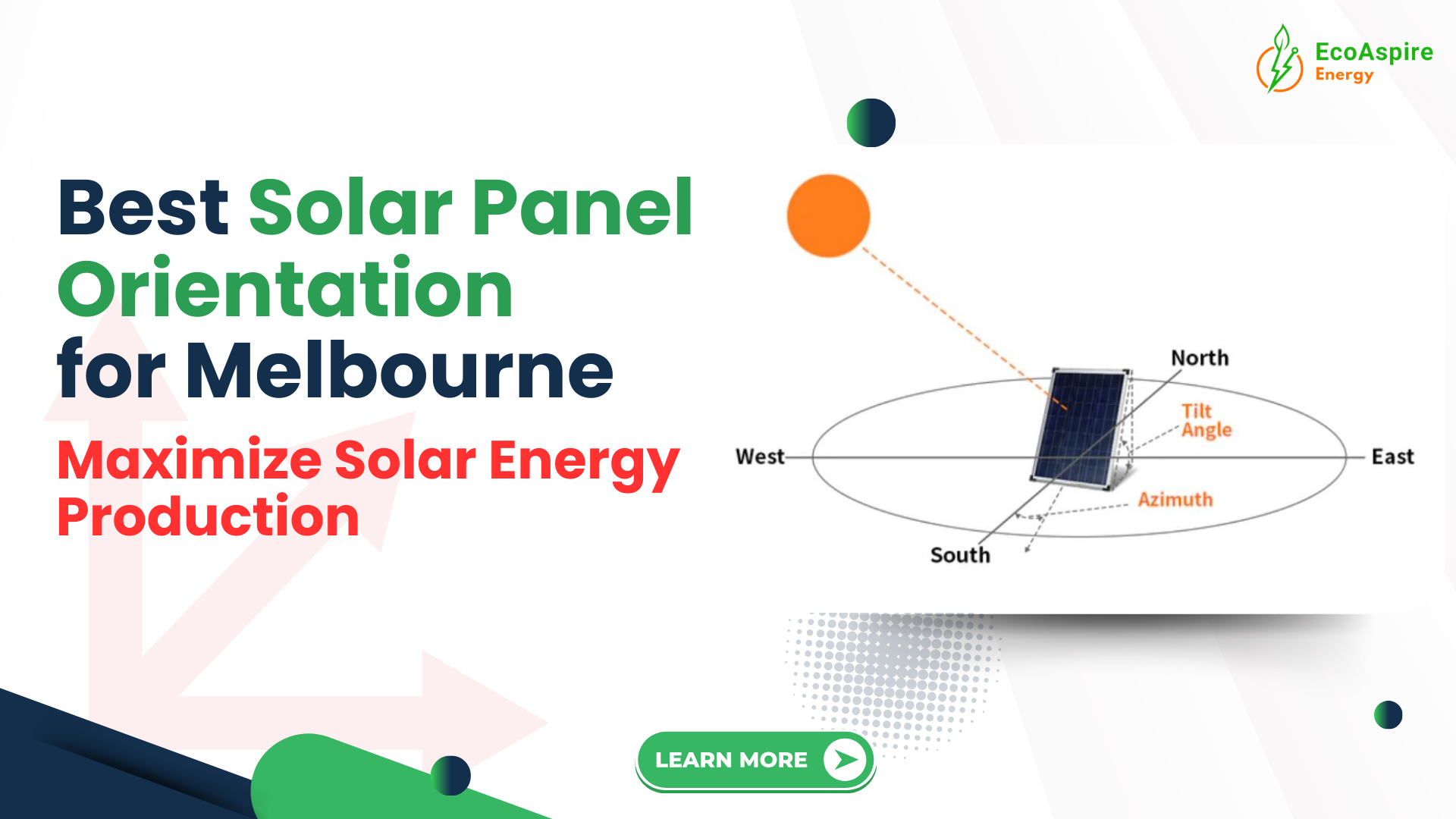
Best Solar Panel Orientation for Melbourne: Maximize Solar Energy Production
The most profitable investments for homeowners and businesses in Australia are through the installation of solar energy systems. A solar energy system’s performance can increase 20-30% just from having their solar panels installed at the optimum direction for solar energy production.
This article aims to educate you about the best practices for the installation of your solar energy system, especially if you live in Melbourne, but also for any location within Australia. All of the data used in this article will be based on trusted resources from the Australian federal government; for instance, The Bureau of Meteorology and The Clean Energy Regulator . If you understand these principles, you will have the ability to take advantage of the benefits of solar energy.
Table of Contents
ToggleWhy Solar Panel Orientation Matters
Solar panels generate electricity by absorbing sunlight. The more direct sunlight they receive, the more energy they produce. In the Southern Hemisphere, this means that panels should capture sunlight from the north as much as possible because the sun is always to the north as it travels from east to west during the day. Poor solar panel orientation can lead to reduced efficiency.
Correct solar panel orientation ensures:
✅ Higher daily and annual energy output.
✅ Better return on investment.
✅ Faster payback time for your solar system.
✅ Lower power bills.
Know Your Roof
The amount of solar usable from your roof depends on the roof’s dimensions, orientation, pitch, and shading.
Roof Direction
Solar panels can be located on roofing surfaces that receive sunlight from the north, east, west sides, or in certain instances, the south side. Panels located on roofs that face north receive the most sunlight during the day, hence produce most electricity. Panels on roofs facing east receive their sunlight earlier in the morning while those on roofs facing west receive their sunlight later in the afternoon.
In the event that you utilize a substantial amount of electricity during early or late hours of the day, consider installing 2 or more sets of solar panels oriented differently. South-facing roofs with panels mounted on them will produce lower electricity and perhaps will not be a cost-effective solution, especially when the roofs are steep.
You may want to consider your roofing decisions with your solar retailer. The combination of different roofing areas will influence their design and inverter type.
Roof Slope
On slanted roofs, solar panels are mounted flat to, or in parallel with, the roof.
Solar panels installed on flat or sloping roofs can be installed in such a way that they are racked on tilt frames in order to tilt them towards the sun. This may increase the power generated per panel; however, there will be gaps in each row of panels. This will ensure that the rows do not shade each other. The cost will be increased due to rack mounting.
Tilt frames may also be installed on a sloping roof. An example is if the available space on the roof is south-facing only. It is feasible to orient the panel by using a rack type installation and go for a north-facing panel.
Shading
It should be noted that solar panels work less effectively if shaded by trees, buildings, or other obstructions. How much the shading takes place depends on the width and location of the shading object, the time of day and season.
Some shading will not create any problem, but when panels receive shade for an extended time, less power will be produced, and it might just not be economical. If there is shading on your roof, discuss your situation with your solar vendor or solar professional about designing your solar electric system around the shade.
You may also want to take into consideration tree growth or developments that may lead to shading.
Best Solar Panel Orientation for Melbourne
Melbourne, located at approximately 37.8° south latitude, has a temperate climate with variable weather. The Bureau of Meteorology data indicates that the city receives an average of 4.5 to 5.5 kWh/m²/day of solar irradiance, making it ideal for solar installations. For maximum solar energy production in Melbourne, aim for the following:
- Azimuth Angle: North-facing (180° azimuth). This orientation captures the most sunlight year-round, as the sun arcs from east to south in the sky.
- Tilt Angle: 30-35° from horizontal. This matches Melbourne’s latitude and accounts for seasonal variations. A steeper tilt (closer to 37°) optimizes winter production, while a shallower one boosts summer output.
Data from the Clean Energy Regulator’s solar map shows that south-facing panels at 30° tilt can yield up to 15-20% more energy than east- or west-facing setups in Melbourne. For example, a 5kW system could produce around 7,000-8,000 kWh annually with optimal orientation, compared to 5,500-6,500 kWh otherwise.
Seasonal Adjustments for Melbourne
Melbourne experiences variable weather, with more clouds in winter and intense sun in summer. Adjust your solar panel orientation seasonally for better results:
- Summer Optimization: Lower the tilt angle to 25-30° to capture the higher sun, maximizing solar irradiance during longer daylight hours.
- Winter Efficiency: Increase to 35-40° to angle toward the lower winter sun, preventing snow accumulation and boosting solar energy production when demand is higher.
This flexibility can further enhance solar panel orientation efficiency, as per ARENA guidelines. These adjustments, supported by Bureau of Meteorology forecasts, can fine-tune solar panel efficiency without complex hardware.
Best Solar Panel Direction In Melbourne
Panel Direction | Angle From Horizontal | |||||||||
0º | 10º | 20º | 30º | 40º | 50º | 60º | 70º | 80º | 90º | |
N | 86% | 93% | 98% | 100% | 100% | 98% | 93% | 86% | 77% | 67% |
NE | 86% | 90.5% | 93% | 94% | 93.5% | 90.5% | 86% | 80% | 72.5% | 64% |
E | 86% | 85% | 84% | 82% | 78% | 74% | 70% | 64% | 59% | 53% |
SE | 86% | 81% | 75% | 68% | 61% | 55% | 49% | 44% | 40% | 35.5% |
S | 86% | 80% | 71% | 62% | 54% | 46% | 39% | 33% | 29% | 27% |
SW | 86% | 81.5% | 76% | 69.5% | 63.5% | 57.5% | 52% | 46.5% | 42% | 38% |
W | 86% | 87% | 87% | 85% | 82% | 78% | 74% | 68% | 63% | 56% |
NW | 86% | 91.5% | 94.5% | 96% | 96% | 91.5% | 89% | 83% | 75% | 66.5% |
What if your panels don’t face north?
If you reside in Australia, and your panels don’t face north, your property may still be suitable for generating solar energy. If your property faces east or west, panels can still generate good yields. Depending on your location and roof pitch, you’re going to lose somewhere between 10 – 20% efficiency as a result of not having panels facing in a due north direction. If you have the option to place the panels in more of a north-east, or north-west direction, it is recommended. This will increase sun exposure to the panels and therefore increase the systems ability to generate solar power.
If your property is constructed in such a way that you are only able to face solar panels in a southerly direction, then you will lose further capacity, as compared to a north facing system. Not every home has a roof that points directly north. If your roof faces north-east or north-west, you can still get excellent solar performance:
- North-East orientation works well for morning generation
- North-West orientation improves afternoon output
- East/West split panels balance production throughout the day
Panels facing east or west may produce slightly less total energy than north, but they can better align with peak energy use times, especially if you tend to use more electricity in the morning or afternoon.
How does battery storage affect orientation
If your solar system has a battery that is able to store excess solar energy, you are somewhat insured against peak morning and afternoon electricity rates. You’re better off positioning your panels in whatever direction will maximize daily solar exposure.
If all the talk of orientation, efficiency percentages and peak electricity rates is too much for you, then the expert solar installers that we refer to you are equipped to answer all of these questions for you. They can design the system based on your property details and electricity consumption habits.
Tips to Maximize Solar Energy Production in Melbourne
To take your solar energy production to the next level in Melbourne:
- Incorporate Solar Trackers: These devices automatically adjust azimuth angle and tilt angle, increasing output by 25-40% – ideal for high-demand households.
- Pair with Energy Storage: Combine with batteries to store excess energy from optimal solar panel orientation, reducing reliance on the grid.
- Monitor and Maintain: Use apps or inverters to track solar irradiance and performance, ensuring your solar panel orientation stays effective.
- Government Incentives: Leverage rebates from the Clean Energy Regulator to offset installation costs for better solar panel efficiency.
- Professional Assessment: Consult certified installers for site-specific calculations, factoring in roof pitch and local bylaws.
By focusing on solar panel orientation, you can achieve net-zero energy goals faster.
Optimize Your Solar Setup Today
Optimizing solar panel orientation is a smart way to maximize solar energy production in Melbourne and across Australia. By facing panels south at a 30-35° tilt, you can significantly increase efficiency, reduce bills, and contribute to a greener future. For personalized advice, consult the Clean Energy Regulator’s resources or contact a local expert.
Ready to go solar? Start with a free consultation today! Talk to our team at Eco Aspire Energy today to get a personalised solar assessment that considers your roof orientation, energy needs, and budget.
[Disclaimer: The information provided in this article is for educational and informational purposes only. While efforts have been made to ensure accuracy, the author makes no guarantees regarding completeness or correctness. Please consult a qualified battery and solar installer to ensure that the information is current, accurate, and compliant with applicable regulations in your jurisdiction.]