

Which Solar System Size Is Best for Your Home?
Properly sizing your solar system is the most critical step in managing your home’s energy costs. Finding the “sweet spot” ensures you generate enough power to slash your daily energy bills without overcapitalising on equipment you do not actually need.
Table of Contents
ToggleIf your system is too small, you will remain heavily reliant on expensive grid electricity. If your system is too large, you will end up exporting a massive portion of your generated power back to the grid for a fraction of what it costs to buy. By analysing your current load profile and planning for the future, you can find the perfect solar size to optimise your savings.
Why the Exact Size of Your Solar System Matters
Selecting the correct solar system size is about much more than just lowering your electricity bill; it is a crucial step toward securing long-term financial savings and true energy independence. If you install a system that is too small, you will remain heavily reliant on expensive grid power to meet your daily needs. Conversely, installing a system that is too large means you will pay a premium upfront for excess energy that is simply exported to the grid for a minimal return. By carefully matching the system size to your household’s unique load profile, daytime power usage, and potential future upgrades, you can easily maximise your return on investment and ensure your home is prepared for tomorrow’s energy demands.
How to Determine the Size of Your Solar System
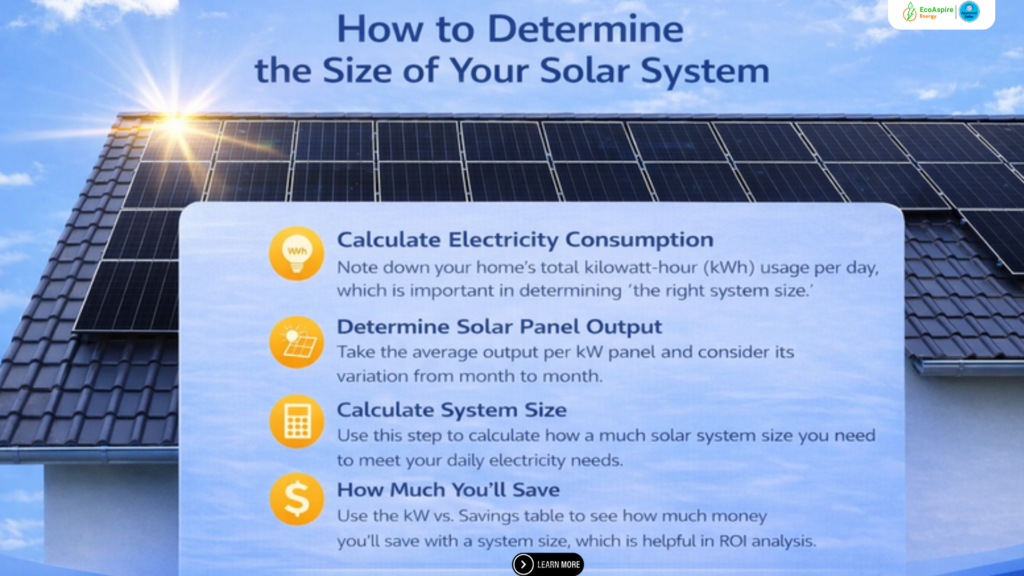
- Calculate Electricity Consumption: Note down your home’s total kilowatt-hour (kWh) usage per day, which is important in determining the right system size.
- Determine Solar Panel Output: Take the average output per kW panel and consider its variation from month to month.
- Calculate System Size: Use this step to calculate how much solar size you need to meet your daily electricity needs.
- How Much You’ll Save: Use the kW vs. Savings table to see how much money you’ll save with a system size, which is helpful in ROI analysis.
Mastering Your Load Profile: Peak Times vs. Daytime Usage
For most Australian homes, electricity usage naturally peaks in the early morning and the evening when the family is home. Unfortunately, this does not align with peak solar generation.
If you install a standard 6.6kW system, your goal should be load shifting. This means running power-hungry appliances — like hot water systems, dishwashers, and washing machines — during the middle of the day. By shifting your usage to match your solar generation, you will drastically increase your 6kW solar system savings and shorten your payback period.
System Size and Savings Comparison
The table below shows the installed cost, annual savings, and payback period for systems ranging from 6kW to 10kW.
System Size | Installation Cost | Annual Savings | Payback Period |
6kW Optimal | $4,910 | $1,437 | 4.2 years |
7kW | $5,930 | $1,563 | 4.5 years |
10kW | $8,190 | $1,922 | 4.9 years |
Note: Unless you have very limited roof space, a standard 6.6kW system (which typically uses a 5kW inverter) is generally the most cost-effective starting point for an average Australian home.
Are you planning to increase the size of your solar system or expand it in the future?
If you plan to increase your home’s electricity usage in the future, such as EV charging, swimming pool, air conditioning or battery installation, it makes sense to go for a slightly larger system. This not only meets future electricity needs, but also reduces the additional cost of expanding the system later. Sizing the system to match current and potential future loads ensures the best solar size for your home and maximizes your ROI in the long run. Therefore, installing a slightly larger system upfront is often more cost-effective.
Here is a quick guide to how future upgrades might impact your required system size.
Future Upgrade | Estimated Extra Usage | Recommended System Size |
Electric Vehicle (EV) | 10–15 kWh/day | 7kW – 10kW |
Swimming Pool | 3–5 kWh/day | 6.6kW – 7kW |
Air Conditioning | 5–8 kWh/day | 6.6kW – 7kW |
Battery Storage | 2–4 kWh/day | 6.6kW – 10kW |
Why it matters: Going for a slightly larger system for future use is often more cost-effective, as expanding the system later increases the cost and complexity.
Limitations and Roof Space Considerations
Before you commit to a massive system, you must consider the physical and regulatory limitations of your property.
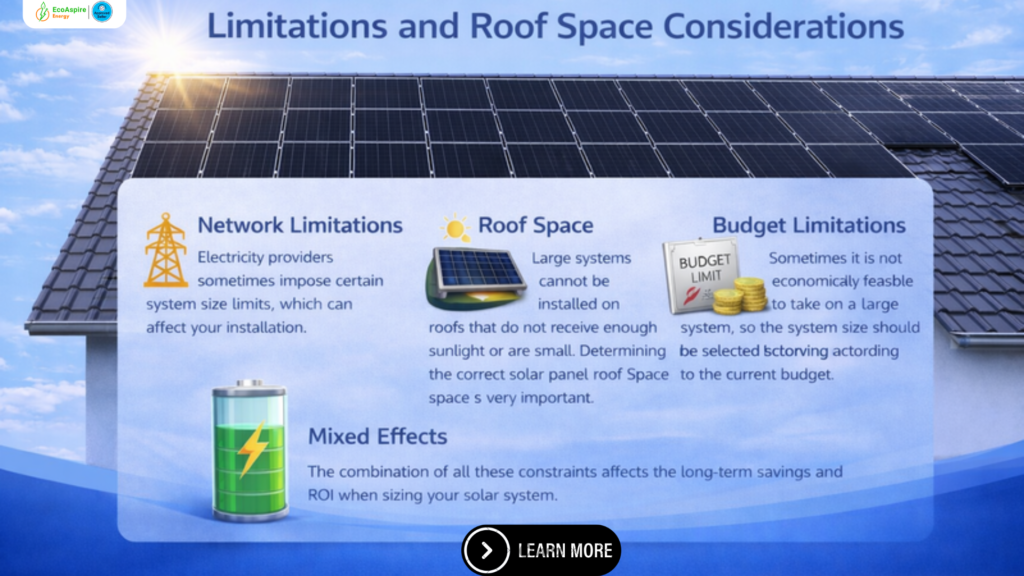
- Network Limitations: Electricity providers sometimes impose certain system size limits, which can affect your installation.
- Roof Space: Large systems cannot be installed on roofs that do not receive enough sunlight or are small. Determining the correct solar panel roof space is very important.
- Budget Limitations: Sometimes it is not economically feasible to take on a large system, so the system size should be selected according to the current budget.
- Mixed Effects: The combination of all these constraints affects the long-term savings and ROI when sizing your solar system.
Battery Storage Considerations
- Battery Needs: Many homes are now installing batteries not just for energy savings, but also for power self-sufficiency and emergencies. Solar batteries store your home’s stored energy and reduce reliance on the grid.
- ROI and Economic Benefits: Battery installation costs are typically high, so increasing savings alone may not always be economically viable. Determining the right solar battery size for home will maximize battery usage and increase return on investment (ROI).
- Energy Self-Sufficiency: If your goal is to be 70–80% self-sufficient, having sufficient battery capacity will allow you to directly use the electricity generated during the day and draw less power from the grid as needed.
- Emergency Backup: Installing a small or medium-sized battery will allow you to only run critical loads such as fridges, lights and security systems, which will avoid disruptions to daily operations.
- Plan for Peak Time Usage: Many Australian homes have time-based tariffs. Batteries can be designed to provide power during high tariff periods, increasing both savings and ROI.
Battery installation not only ensures savings but also future energy management and safety in emergency situations. Selecting the right size battery ensures both long-term profitability and self-sufficiency.
FAQs
- How do I calculate what size solar system I need?
You should choose a system based on your daily electricity usage, your current tariffs, and your available roof space. You can find your daily average usage clearly printed on your last electricity bill. - Is a 10kW solar system too big for a home?
A 10kW system is brilliant if you have a large household, a swimming pool, ducted air conditioning, or an electric vehicle. However, it is usually an unnecessary expense for a small, energy-efficient household. - Is a 6.6kW solar system big enough?
Yes, a 6.6kW solar system easily covers the daytime usage of most average Australian homes. It is currently the most popular system size across the country due to government rebate structures. - How much will I save with a 6kW solar system?
A typical 6.6kW system can save you between $1,400 and $1,500 per year, provided you actively shift your heavy appliance usage to the middle of the day. - Can I expand my solar system later?
While it is technically possible, expanding an older system is often financially unviable due to installation costs and matching new panels with old inverters. It is almost always cheaper to install a slightly larger system from day one.
[Disclaimer: The information provided in this article is for educational and informational purposes only. While efforts have been made to ensure accuracy, the author makes no guarantees regarding completeness or correctness. Please consult a qualified battery and solar installer to ensure that the information is current, accurate, and compliant with applicable regulations in your jurisdiction.]