

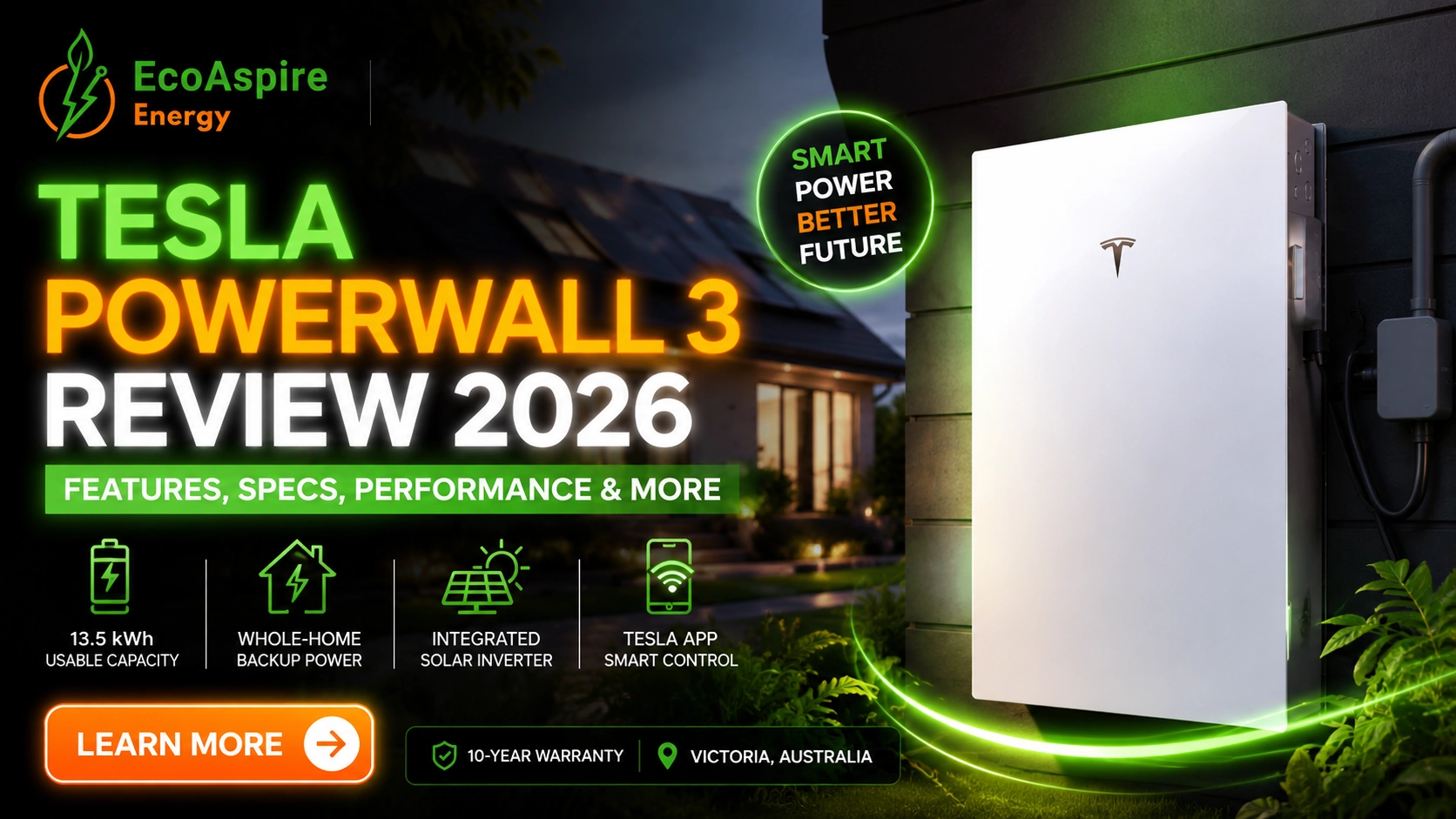
The Tesla Powerwall 3 review is difficult to complete without looking beyond battery capacity alone. Tesla has designed Powerwall 3 as an integrated solar and battery system, combining battery storage, an integrated solar inverter and energy management in one system.
Table of Contents
ToggleFor Victorian homeowners, its biggest advantages are its 13.5 kWh usable energy capacity, high power output, integrated solar inverter, whole-home backup capability, Tesla App monitoring and expansion options.
Tesla’s Australian technical documentation lists Powerwall 3 with configurable AC output options of 5 kW, 10 kW or 11.04 kW, while Tesla’s consumer-facing Australian page currently describes on-grid and backup power as up to 10 kW depending on local conditions. The exact configuration therefore matters when comparing systems for a Victorian property.
Overall, Powerwall 3 is a premium battery option for homeowners who want more than simple energy storage. It is particularly attractive for households looking for solar self-consumption, backup protection, energy monitoring and a system that can be expanded over time.
What Is Tesla Powerwall 3?
Tesla Powerwall 3 is a fully integrated solar and battery system designed to store electricity and make it available when your home needs it. Instead of sending all excess solar generation to the grid during the day, a Powerwall system can store surplus energy and make that energy available later, including at night or during a grid outage. Tesla says Powerwall can also be managed through the Tesla App, allowing homeowners to monitor energy use and customise system behaviour.
One of Powerwall 3’s major differences is its integrated solar inverter. Tesla says this allows solar to be connected directly to Powerwall 3 and can also make it suitable for new solar installations or some existing solar systems. Tesla states that Powerwall 3 is compatible with major solar inverter brands for supporting existing systems.
For homeowners in Victoria, this can make Powerwall 3 worth considering when designing a new solar and battery system or assessing an existing solar installation. Once installed, you manage the whole system through the Tesla mobile app, where you can monitor solar generation, battery charge levels, energy usage and backup status in real time, and customise how the system behaves based on your household’s energy goals.
Tesla Powerwall 3 Review: Specifications & Technical Details
Here are the genuine, manufacturer-published technical specifications for the Tesla Powerwall 3 and its companion products.
Battery & Power Specifications
Specification | Detail |
Total battery energy | 14 kWh |
Usable battery energy | 13.5 kWh |
Nominal output power (AC) | Up to 11.04 kW |
Maximum continuous current | 48 A |
Solar input (STC) | Up to 20 kW DC |
Number of MPPTs | 3 |
Load start capability | 185 locked rotor amps (LRA) |
Solar-to-battery-to-home efficiency | 89% |
Solar-to-home/grid efficiency | 97.5% |
Scalability | Up to 4 Powerwall 3 units, plus up to 3 Expansion units per Powerwall (7 units total) |
Warranty | 10 years |
Physical & Environmental Specifications
Specification | Detail |
Dimensions | 1105 x 609 x 193 mm |
Weight | 130 kg |
Mounting | Floor or wall mount, indoor or outdoor rated |
Operating temperature | –20°C to 50°C |
Enclosure rating | IP55 (wiring), IP67 (battery & electronics) |
Operating noise | Under 50 dB(A) typical |
Grid connection compliance | AS/NZS 4777.2 (Australia & New Zealand) |
Tesla’s Australian technical specifications provide the detailed configuration-dependent figures, while Tesla’s consumer page highlights 13.5 kWh capacity, up to 10 kW on-grid/backup power depending on local conditions, 97.5% solar-to-grid efficiency, 185 A motor start capability and a 10-year warranty.
👉For See more Tesla Powerwall 3 Specifications — Click here
Backup Gateway 2
Most Australian installations pair the Powerwall 3 with Tesla’s Backup Gateway 2, which manages grid connection, outage detection and backup power switching. It supports single-phase and three-phase feed-in, has a revenue-accurate AC meter, and carries the same 10-year warranty as the battery itself — a detail many homeowners overlook when comparing total system value.
Key Benefits of the Tesla Powerwall 3
Tesla Powerwall 3 is a system that integrates battery storage, solar energy conversion, and energy management into one system. It enables the homeowner in Victoria to gain better control of their solar energy, become less dependent on grid electricity, and get backup power in case the grid fails. Below are some of the advantages that you need to consider before listing out its features:
1. All-in-one design
The Powerwall 3 combines the battery, inverter, and solar power electronics in one system, thus avoiding the use of multiple parts and wall-mounted units. This can make the installation look cleaner and be easier to install compared to other systems that use a separate battery inverter.
2. 13.5 kWh Usable Battery Capacity
The Powerwall 3 offers 13.5 kWh of energy storage capacity. In the case of a typical household in Victoria, this storage capacity could help transfer the production from day time solar generation to evening consumption. The duration that this amount of storage will last is determined solely by the demand of the household.
For instance, a household with low electricity usage in the nighttime would drain its battery slower compared to one that has high demand devices such as air conditioning, heating, water heater and others.
This is precisely the reason why when choosing a battery size you have to consider your house’s electricity usage.
3. Up to 11.04 kW AC Output
One of the strongest technical features highlighted in Tesla’s Australian technical documentation is Powerwall 3’s configurable output. Tesla lists 5 kW, 10 kW and 11.04 kW nominal AC output configurations, with the maximum output/current depending on the installed configuration and applicable local requirements.
This is important because battery capacity and power output are not the same thing.
- Capacity determines how much energy the battery can store.
- Power output determines how much electricity it can supply at a given time.
Powerwall 3’s higher power capability can be particularly useful for homes with larger simultaneous loads.
4. Integrated Solar Inverter
One of the biggest reasons to consider Powerwall 3 is its integrated solar inverter. Tesla designed Powerwall 3 so solar can connect directly to the battery system. Tesla says Powerwall 3 can be installed with new solar or added to supported existing solar systems.
Tesla’s Australian technical documentation specifies:
- Up to 20 kW DC solar input
- 3 MPPTs
- PV DC input voltage range of 60–550 V DC
- MPPT voltage range of 60–480 V DC
- Up to 30 A maximum current per MPPT on applicable units
The exact system design must be assessed against the property, solar array and applicable electrical requirements.
5. Whole-Home Backup for Victorian Homes
Backup power is among the primary factors that make most people purchase Tesla Powerwall. Tesla claims that Powerwall provides whole-home backup capacity to most homes that are well-designed and well-configured. In case of any outage, the Backup Gateway controls the communication network among the home, Powerwall, and grid to supply backup power.
But having a whole-home backup power does not necessarily mean that all homes will be equally capable of providing such backup power.
Tesla recommends system design based on factors such as:
- Home electricity consumption
- Solar system size
- Number of Powerwalls
- Powerwall model
- Property characteristics
- Local electrical requirements
A professional site assessment is therefore important before installation.
Tesla Powerwall 3 Price in Australia
One of the most common searches related to this product is Tesla Powerwall 3 price Australia. Tesla does not publish one universal installed price that applies to every Australian property. Tesla’s Australian support page states that customers interested in ordering Powerwall 3 are connected with a Tesla Certified Installer, who provides pricing and recommends the appropriate Powerwall model for the home.
The final installed cost can vary depending on factors such as:
- Battery configuration
- Number of Powerwalls or Expansion units
- Solar system requirements
- Backup configuration
- Switchboard work
- Installation requirements
- Electrical and network requirements
- Applicable government incentives
For this reason, homeowners should compare complete installed system quotes, rather than comparing battery prices alone.
📞 Want to Know the Latest Tesla Powerwall 3 Price? Get a Free Quote from Eco Aspire Energy.
Tesla Powerwall 3 Installation Process in Melbourne & Victoria
When you choose Eco Aspire Energy for your Tesla Powerwall 3 installation, here’s what the process typically looks like:
- Free consultation — we discuss your household’s energy usage, backup needs and goals.
- Custom system design — sized to your actual consumption, not a one-size-fits-all package.
- Design review — our solar experts double-check the design before anything is ordered.
- Paperwork and compliance — we handle Energy Safe Victoria compliance, network connection applications and Clean Energy Council documentation on your behalf.
- Installation and grid connection — carried out by our own A-grade electricians and SAA-accredited installers (we don’t subcontract).
- Testing and commissioning — the system is tested and switched on.
- App setup and handover — we configure the Tesla app and walk you through managing your new system.
- Ongoing support — backed by our 5-year workmanship warranty, on top of Tesla’s 10-year product warranty.
👉 Ready to store your solar energy? Contact Eco Aspire Energy today for a free quote.
Tesla Powerwall 3 and Existing Solar Systems
There is no need to acquire Powerwall 3 along with your solar system at once. According to Tesla, Powerwall 3 may be fitted into suitable pre-installed solar systems and is compatible with most solar inverters. Therefore, it is a suitable option for the Victorian residents who have their solar panels installed but want more energy storage options. However, it must be noted that pre-existing solar systems should be evaluated before choosing the battery. Your inverter, capacity of solar panels, switchboard, electrical connection, and network will play a role in determining your end design.
According to the technical information from Tesla, each unit of the Powerwall 3 Expansion adds 13.5 kWh of energy capacity to Powerwall 3.
This creates potential configurations of:
- Powerwall 3: 5 kWh
- Powerwall 3 + 1 Expansion: 27 kWh
- Powerwall 3 + 2 Expansions: 5 kWh
- Powerwall 3 + 3 Expansions: 54 kWh
Tesla’s documentation also states that up to four Powerwall 3 units may be supported, subject to market and system limitations.
The important distinction is that Powerwall 3 Expansion adds energy capacity rather than acting as a separate Powerwall 3 with its own integrated inverter.
Tesla Powerwall 2 Review vs Powerwall 3 Review: Which Is Better?
Both Tesla Powerwall 2 and Powerwall 3 offer 13.5 kWh of usable battery capacity and a 10-year warranty, but Powerwall 3 brings significant improvements in power output, solar integration and system expansion.
Feature | Tesla Powerwall 2 | Tesla Powerwall 3 |
Battery Chemistry | Lithium-ion (NMC) | LFP (Lithium Iron Phosphate) |
Usable energy | 13.5 kWh | 13.5 kWh |
Continuous Power Output | 5 kW | ● On-grid Power: up to 10 kW ● Backup Power: up to 10 kW, depending on local conditions. |
Integrated Inverter | No (Battery only) | Integrated solar inverter |
Solar input | Depends on external inverter | Up to 20 kW DC |
Expansion | Up to 10 units | Up to 4 Powerwall 3 units + Expansion options |
Weight | 114 kg | 130 kg |
Dimensions | 1,150 × 753 × 147 mm | 1,105 × 609 × 193 mm |
Warranty | 10 years | 10 years |
Tesla Powerwall 3 in Victoria: How Does It Perform?
There is a variety of energy needs in households in Victoria. For instance, energy needs in a house in Melbourne would be quite different from energy needs in a bigger property in one of the regions of Victoria. Climate control could play an important role in how much electricity would be needed while the amount of solar energy generation varies depending on the season.
Powerwall 3 allows using more of your generated solar energy instead of purchasing grid electricity.
For Victorian homeowners, the practical value of Powerwall 3 therefore depends on:
- Your daily electricity consumption.
- Your existing or planned solar capacity.
- Your evening and overnight electricity usage.
- Whether backup power is important to you.
- Your home’s electrical configuration.
- Your budget and expected payback period.
Tesla Powerwall 3 Warranty
The Powerwall 3 comes with a 10-year warranty from Tesla for Australia and New Zealand. The Tesla warranty document also provides details of the applicable Powerwall 3 warranty for products and energy capacity.
A 10-year warranty offers an essential level of assurance to homeowners thinking about making a long-term commitment to energy storage.
However, homeowners should always read the current Tesla warranty document for the specific terms, conditions and exclusions applicable to their installation.
Tesla Powerwall 3 Rebate in Victoria
Victorian homeowners may be eligible for support through the Australian Government’s Cheaper Home Batteries Program, which can reduce the upfront cost of an eligible Tesla Powerwall 3 installation. For eligible installations, the incentive is applied as a point-of-sale discount, meaning you don’t need to claim a traditional rebate after installation.
Eco Aspire Energy is an accredited installer under the program and can apply the eligible battery incentive at the point of sale.
The exact discount depends on the battery’s eligible capacity, the current rebate rate and the program rules applicable when your system is installed. Because these rates and requirements can change, Eco Aspire Energy confirms your current eligibility and applicable incentive at the quotation stage, helping you understand the expected final cost before installation.
Why Choose Eco Aspire Energy?
At Eco Aspire Energy, we don’t believe in one-size-fits-all solar and battery systems. Every system is designed around the property’s energy usage and requirements. Our installation process includes consultation, system design, design review, paperwork and permits, installation, testing, grid connection and monitoring setup.
We also provide a 5-year workmanship warranty on installed solar PV systems. If you’re considering Tesla Powerwall 3 in Melbourne or regional Victoria, our team can assess your property and help determine whether Powerwall 3 is suitable for your energy requirements.
At Eco Aspire Energy, we take a property-specific approach to solar and battery installations. Eco Aspire Energy is a 100% Australian-owned and operated solar company. The company’s founder is an A-grade electrician and SAA-accredited solar and battery installer with more than 15 years of hands-on experience.